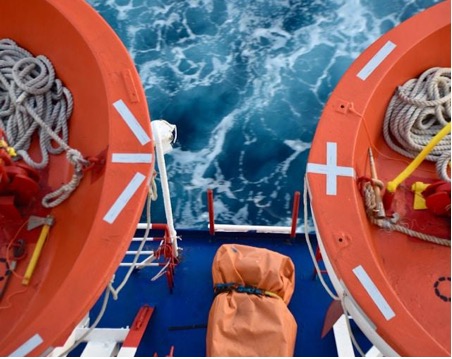
A life raft for your boat is the last safety net in a situation where the vessel must be abandoned. Choosing the right raft depends on your sailing area, crew size, and intended use: for the archipelago and coastal waters, an ISO 9650-2 standard raft is enough, while offshore and racing sailing requires the more demanding ISO 9650-1 class. This guide covers all the key selection factors – from raft types to storage and service intervals.
Browse Marinekauppa's life raft range and find the right model for your boat's needs.
What should you consider when choosing a life raft?
Choosing a life raft comes down to four main factors: sailing area (archipelago or offshore), maximum crew size, storage space on the boat, and service availability. The wrong choice can mean the raft doesn't pass a racing inspection, or can't withstand offshore conditions.
In Finland, Traficom is responsible for boating safety, and requirements are based on international ISO standards. A life raft is mandatory in certain racing classes and recommended on any vessel sailing offshore or on long routes.
Image name: choosing-a-life-raft-for-your-boat
ALT text: A life raft suited to the boat, stowed and ready for an emergency
Life raft types – ISO 9650-1 vs. ISO 9650-2
Life rafts fall into two main classes based on area of use. The comparison table below summarizes the key differences:
Sea Safe Pro Light rafts are an example of ISO 9650-1 Group A standard rafts, certified by Germanischer Lloyd and meeting ISAF racing requirements.
ISO 9650-1: for offshore and racing
An ISO 9650-1 raft is designed to survive demanding conditions more than 60 nautical miles from shore. A raft in this class must have: independent double chambers in the buoyancy tubes and arch, at least 220 liters of ballast bags for stability in waves, a thermally insulated floor against cold water, plus a complete survival equipment pack including a fresh-water collector and a sea anchor. Boarding is possible via a ramp or ladder even in heavy waves.
ISO 9650-1 is practically the only option if you take part in offshore races like the Gotland Runt or are planning an Atlantic crossing. Keep in mind that an ISO 9650-1 rating alone isn't always enough – some races separately require an "over 24 hour" equipment pack, so check the race's rules in advance.
ISO 9650-2: archipelago and coastal boating
An ISO 9650-2 raft suits the Finnish archipelago, the Baltic coast, and inland waters. This class is lighter, more affordable, and easier to stow than an offshore-class raft. The construction is simpler, but the raft still offers adequate protection for shorter emergencies, where help arrives more quickly.
In Finnish archipelago conditions, an ISO 9650-2 class life raft is a sufficient and sensible choice for most leisure boaters – what matters most is that a raft is on board at all, and that it's properly serviced.
What size life raft does your boat need?
Capacity is chosen based on the maximum number of people that could be on board. The practical rule is simple: the raft's capacity should match the boat's maximum permitted number of persons.
4-person raft – suits small family and day-sailing boats, day boats, and smaller sailboats
6-person raft – the most common choice for 30–40 foot sailboats and family boats
8–12 person raft – larger vessels, charter boats, and professional use
It's better to choose one size class larger than your actual crew count. A larger raft has more room to move, equipment is easier to use, and it's easier for someone physically weakened to climb aboard. Weight ranges from about 18–25 kg for a 4-person model to about 22–30 kg for a 6-person model.
Life raft storage: canister or valise?
Rafts are sold in two different packaging formats, and the choice affects both storage and deployment:
Canister (hard case)
A fiberglass hard canister effectively protects the raft from UV radiation, moisture, and mechanical damage. A canister model is excellently suited to a deck-mounted cradle (a life raft cradle), from which the raft can be launched quickly. A hydrostatic release unit automatically releases the raft at a depth of about 4 meters if the vessel sinks. A canister is the preferred option when you want to keep the raft readily accessible on deck.
Valise (soft bag)
A raft packed in a valise is lighter and easier to fit into a tight space, such as a cockpit locker or under a bunk. It's a more affordable option, but always requires manual deployment by pulling the painter line. A valise suits vessels with limited storage space, as well as inland-water boats.
With either model, the raft must be easily accessible in an emergency – where you stow the raft matters just as much as the raft's own quality.
The Hammar hydrostatic release unit – automatic safety
A hydrostatic release unit is a mechanism that automatically releases the raft if the vessel sinks. The Hammar H20 release activates from water pressure at a depth of up to 4 meters: a sharp blade cuts the securing line, the raft's painter line tightens, and the raft begins to inflate. This means the raft floats to the surface and inflates itself – even if the crew doesn't have time to launch it manually.
For smaller rafts (4-person and non-SOLAS models), the Hammar Small Rafts unit is recommended, which has a special weak link. A hydrostatic release unit is an investment worth making with any canister-style raft.
Life raft maintenance and service interval
Life rafts require regular servicing to ensure they work properly. The service interval per the standard is 3 years – for both ISO 9650-1 and ISO 9650-2 class rafts. During service, the raft is opened, inspected, and repacked by certified specialists at a service station.
Sea Safe life rafts are serviced by Mereabi OÜ, and service time is normally 3–6 weeks. Service costs start at around €1,500 depending on the raft model. It's worth booking service well ahead of the start of the boating season.
It's also worth checking annually:
The canister or valise – no cracks, dents, or UV degradation
The securing lines and hydrostatic release unit – no corrosion or damage
The last service date – usually shown on the canister or a label
The stowage location – is the raft unobstructed and quickly reachable
Please note that a 12-year warranty requires following the regular 3-year service interval. Without proper servicing, the warranty is voided.
A life raft's equipment pack – what's inside?
The survival equipment pack in an ISO 9650-1 class life raft typically includes the following:
SOLAS-approved exterior and interior lights
SOLAS reflective tape on the raft
A sea anchor to stabilize the raft
A fresh-water collection system
A 30-meter heaving line with a buoyant/heaving ring
A boarding ladder or ramp
A repair kit
ISO 9650-2 rafts have a more limited equipment set, but still include basic safety gear. If you take part in long offshore races, it's worth considering a separate grab bag as backup to the raft.
Other safety equipment to support a life raft
A life raft works best as part of a broader safety system. Alongside it, a boat should have:
Life jackets – for every crew member, preferably automatic inflatable jackets for long passages
An emergency beacon (EPIRB or PLB) – sends an automatic distress signal to maritime rescue
LED flares and pyrotechnics – signaling devices for an emergency
An MOB (man overboard) rescue system – for man-overboard situations
A VHF radio – for communication with maritime rescue and other vessels
You'll find a comprehensive guide to choosing life jackets in our separate article comparing life jackets, which covers the differences between automatic inflatable jackets, buoyancy aids, and traditional life jackets in more detail.
Archipelago vs. offshore – which life raft is right for you?
Here's a quick summary guide to choosing the right raft for Finnish boating:
Frequently asked questions about life rafts
Is a life raft mandatory in Finland?
For leisure boaters, a life raft isn't legally mandatory in Finland on a coastal or inland-water boat. It is, however, mandatory in most offshore races and highly recommended on any long sea passage. Requirements are stricter for professional shipping.
How often does a life raft need servicing?
The service interval is 3 years. Service must be done at a certified service station to keep the raft's 12-year warranty valid. During service, the raft is opened, inspected, the gas cylinder is replaced, and the pack is repacked.
How is a life raft deployed?
A life raft is deployed by pulling the painter line firmly. Pressurized gas (CO₂) inflates the raft's air chambers in about 30–60 seconds. A raft fitted with a hydrostatic release unit also releases automatically if the vessel sinks to a depth of about 4 meters.
What is a life raft's service life?
With regular servicing, a raft's service life is 12 years from its manufacture date. This requires following the three-year service interval without exception. If servicing is neglected, the warranty and certification are voided.
Can I store a life raft in a home storage unit over winter?
Yes, a life raft can be stored over winter in a dry, warm storage space. The raft shouldn't be exposed to freezing temperatures or extremely hot spaces (e.g., a warm garage in summer heat). Check the manufacturer's instructions for the recommended storage temperature – generally a suitable range is 0–45°C.
Get a life raft from Marinekauppa
A life raft for your boat is a serious safety investment – it's not something to skimp on. In Marinekauppa's range you'll find life rafts for both archipelago and offshore use, plus everything needed for safe raft use: cradles, hydrostatic release units, and service arrangements.
Always pair your raft with a proper life jacket, an emergency beacon, and signaling equipment – this ensures comprehensive safety gear in all waters.
Sources and further reading
Traficom – Boating safety
ISO 9650 – Inflatable liferafts (International Organization for Standardization)
Suomen Meripelastusseura (Finnish Lifeboat Institution) – Safety guidelines
Feature | ISO 9650-1 (Offshore) | ISO 9650-2 (Coastal) |
Area of use | Offshore, over 60 miles from shore | Coastal, archipelago, inland waters |
Equipment | Complete survival pack, fresh-water collector, sea anchor | Basic equipment, simpler contents |
Construction | Double-chamber design, thermal floor, self-righting | Simpler construction |
Service interval | 3 years | 3 years |
Price level | €1,200–2,500 (4–6 person) | €500–1,200 (4–6 person) |
Race eligibility | Approved for most offshore races | Generally not approved for offshore races |
Sailing area | Recommended raft | Additional note |
Finnish inland waters | ISO 9650-2 or -3 | Help arrives quickly; a lighter model is enough |
Archipelago Sea and coast | ISO 9650-2 | The most common choice for Finnish leisure boaters |
Baltic Sea, long crossings | ISO 9650-1 | More demanding conditions require a higher-spec raft |
Offshore races | ISO 9650-1, over-24h equipment | Check the race's specific requirements |
Ocean sailing | ISO 9650-1 + grab bag | The highest-spec equipment; check ARC/ISAF rules |
Disclaimer
This guide provides general guidance only and does not replace the product manufacturer's operating, installation, or service instructions. Marinekauppa is not responsible for actions taken based on this guide or their consequences. Always check product-specific instructions and consult a qualified professional if needed.