Boat Toilet Guide – Choosing the Right Toilet for Your Boat
Choosing the right type of toilet for a leisure boat is important for comfort and convenience on the water. A well-designed system can offer the same level of comfort as at home. A toilet system can also include a holding tank, but the choice is up to the boater. It is important to remember that every system requires maintenance. In this guide, we cover different toilet solutions intended for marine use and provide tips to help you find the option that best suits your needs.
Types of Marine Toilets
Portable Toilets
Pros
-
Lightweight and easy to move
-
Simple or no installation required
Cons
-
Small tank capacity
-
Frequent emptying needed
-
Requires chemical additives
A portable toilet is a good choice when a holding tank is not wanted or cannot be installed. Usually it is enough to place it where it is needed, fill it with water and additives, and it is ready to use. Some models can also be fixed in place so the toilet stays secure in rough conditions.
The downside is limited capacity. The tank must be emptied outside the boat, for example into a land-based toilet or a holding tank pump-out station. Remember that discharging toilet waste into Finnish waters is strictly prohibited. Chemical additives are also required to control odors.
Manual Toilets Connected to a Holding Tank
Pros
-
Large capacity possible
-
Less frequent emptying and maintenance
Cons
-
Requires installation
-
Needs a holding tank
-
Heavier solution
When a boat is fitted with a toilet connected to a holding tank, the capacity depends on the tank size. The toilet is connected to the tank using sanitation hose.
A manual toilet offers more comfort and resembles a home toilet. A hand pump next to the toilet is used to bring in flush water and transfer waste into the holding tank. Toilets come in various sizes: larger models feel more like home, while smaller ones fit tight spaces.
The toilet needs a connection to both the holding tank and a water source for flushing, which may be fresh water or seawater. Seawater helps conserve fresh water but can create odors, so a coarse filter or activated carbon filter is recommended. Fresh water flushing generally offers the best comfort.
Electric Toilets Connected to a Holding Tank
Pros
-
Highest comfort and capacity
-
Less frequent emptying on short trips
Cons
-
Heavier and requires electricity
-
Requires installation and a holding tank system
An electric toilet provides maximum comfort, almost like at home. It must be connected to a holding tank and operates at the push of a button.
Some models include their own flush water pump, while others use the boat’s pressurized water system. Waste is transferred to the holding tank with an electric pump, and most models include a macerator to help prevent clogs.
As with manual toilets, you must choose between fresh water or seawater for flushing. When selecting a model, check whether it is compatible with a pressurized water system or requires its own pump.
Capacity and Size
How long you can stay on board before emptying the toilet depends on usage and tank size. The larger the capacity, the less frequently emptying is required.
For example:
-
A portable toilet with a 10 to 20 liter tank may need daily emptying if several people use it.
-
If you want to avoid manual emptying and have many users, a toilet with a holding tank is much more convenient.
-
A 50 liter holding tank is typically sufficient for a 10 meter boat.
-
Discharging toilet waste into Finnish waters is prohibited.
Larger boats with more space and more users benefit from a fixed toilet with a proper sanitation system. Holding tanks range from 25 to 100 liters, meaning they do not need to be emptied every day. It is commonly recommended that 50 liters is adequate for a 10 meter boat.
Older boats may still have toilets discharging directly overboard, but this is no longer allowed in Finnish territorial waters. On international waters, holding tank discharge may be permitted.
Installation and Maintenance
Portable Toilets
The biggest benefit is minimal installation, but maintenance is still required:
-
Add chemicals and flush water during each fill and emptying
-
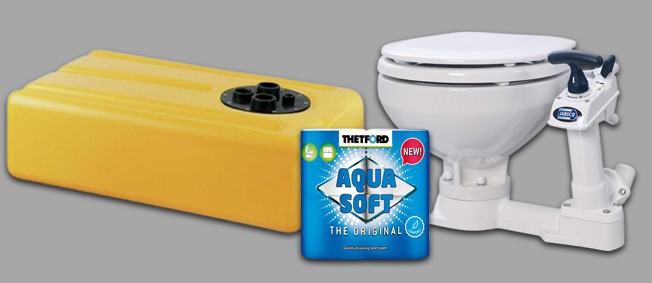
Use soft toilet paper specifically designed for portable toilets
-
Keep the toilet clean and empty it before storing
Fixed Toilets and Holding Tank Systems
If your boat does not yet have a toilet system, several components are required:
-
Manual or electric toilet
-
Holding tank with suitable capacity
-
Deck fitting for pump-out
-
Ventilation outlet
-
Sanitation hoses and flush water hoses
-
Connectors, brackets, and possibly electrical components
If you want the ability to discharge the tank overboard on international waters, you will also need a through hull fitting below the waterline and a pump.
If a system is already installed, usually only components need replacing.
Odors on Board?
Sanitation hoses have a limited lifespan. They may remain watertight but allow odor molecules to pass through if their diffusion resistance decreases. This can cause unpleasant smells even without visible leaks. The solution is to replace the hoses.
Odors can also result from flushing with untreated seawater. When seawater sits in the system, microorganisms and organic matter may create bad smells.
Tips to prevent odors:
-
Always use soft, marine-safe toilet paper
-
Flush the system regularly with appropriate cleaning agents
-
Empty the holding tank whenever the boat is not in use
-
Add biodegradable antifreeze during winter storage
-
Check fittings and seals regularly
Cost and Budget
If your budget is limited, a portable toilet is the most affordable and easiest solution. It works well for short trips.
If you spend long periods on the water, a toilet with a holding tank offers much more comfort. Costs are higher, as multiple components are needed, but for many boaters it is a worthwhile investment that significantly improves comfort on board.
Prices vary widely between small manual toilets and full-size electric toilets. The final choice depends on your budget and the level of comfort you want.
Summary
The key questions when choosing a boat toilet are:
-
How many people will use it?
-
How often are you willing to empty the tank?
-
What level of comfort do you need?
-
Is there enough space for a fixed system?
If you want home-level comfort on board, a proper system requires some investment but can greatly enhance your overall boating experience.
Come explore different options at Marinekauppa and ask our experts for help to find the perfect toilet solution for your boat.