B&G Autopilots
You can find B&G autopilots for your boat in the diverse selection of Marinekauppa.Product groups
B&G Autopilots group products
Campaign
Stock Clearance!
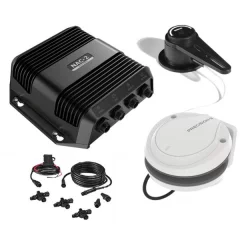
The NAC-2 autopilot computer is the brain of the Simrad autopilot system. It contains the electronics required to operate a hydraulic steering pump or mechanical steering, as well as an interface to other components such as steering sensors and rudder angle sensors. The NAC-2 is designed for vessels up to ten meters (35 feet) in length and can operate low-current pumps, mechanical steering and solenoid valves (8 amps continuous and 16 amps peak).
Main features
- Reliable autopilot based on Simrad Continuum steering technology
- Recommended for boats up to 10 meters (35 feet) in length
- Continuous power 8 amps, peak power 16 amps
- Switch output (up to 3 amps)
- Compatible with low-flow duty pumps, mechanical actuators, hydraulic linear actuators and solenoid valves
- Virtual rudder angle sensor makes installation easier on boats with outboard motors (outboard or sterndrive)
- Supports Simrad RF25 rudder angle sensors
- Plug and play connectors make installation easy
- NMEA 2000® connectivity for heading sensors, rudder angle sensors, separate autopilot control panels and multifunction displays
Simrad Continuum steering technology
Every Simrad steering innovation is based on over sixty years of experience in autopilot development. This development continues at Simrad Yachting’s autopilot research center in Norway. The result of this development is, for example, the Continuum algorithm, which is the software that drives Simrad steering technology. Continuum brings years of research and experience on the water to the helm. It is an intelligent pilot you can trust to steer.
Standard power
The NAC-2 autopilot computer is recommended for boats up to 10 meters (35 feet) in length. It has a continuous output of up to 8 amps and a peak output of 16 amps. It also has a switch output. It is suitable for controlling low-current duty pumps such as the Simrad RPU80, mechanical drives such as the Simrad SD10, hydraulic linear duty units such as the HLD350 series, and solenoid valves.
Virtual Rudder Feedback
Simrad Virtual Rudder Feedback technology eliminates the need for a separate rudder feedback sensor on boats equipped with outboard engines (outboard or sterndrive). This reduces the overall cost and simplifies the autopilot system. It is ideal for applications where a rudder feedback sensor cannot be used due to mechanical limitations.
Rudder angle sensors
Rudder angle sensors are mechanically attached to the rudder and continuously report the rudder position to the autopilot computer. This allows the Simrad Continuum steering algorithm to make the best possible steering decisions. These sensors are typically used on sterndrive boats, larger vessels, and in special applications where a virtual rudder angle sensor cannot be used. The NAC-2 supports SimNet or NMEA 2000® connected Simrad RF25 angle sensors and resistive rudder angle sensors.
Easy to install
Plug and play connectors simplify installation and minimize the wiring required for an autopilot system installation. Industry-standard NMEA 2000® connectivity allows easy connection of steering sensors, rudder angle sensors, autopilot control panels and multifunction displays to any location on the boat.
Main features
- Heading, rate of turn (ROT), roll, pitch and roll displacement via NMEA 2000® network
- Accurate and reliable semiconductor sensor technology
- Steering direction accuracy ±2° after calibration
- Easily adjustable bracket can be mounted on bulkhead or mast
- IPX7 waterproof for external mast mounting on steel-hulled vessels
- Easy installation – single NMEA 2000® connection
- One compact sensor measures steering direction, yaw rate, roll, pitch and yaw, and horizontal displacement
- Reliable solid-state sensor technology – no moving parts
- Easy and affordable installation
- Suitable for most hull types, including mast mounting on steel-hulled vessels
NMEA 2000® – heading and rate of turn information
The Simrad Precision-9 compass uses a NMEA 2000® network to provide heading, rate of turn (ROT), roll, pitch and roll, and horizontal displacement to connected devices including autopilots, radar, sonar, multifunction displays, and other navigation systems.
Semiconductor sensor technology
The Precision-9 compass uses an advanced solid-state sensor system based on MEMS technology. This highly accurate system measures motion in nine axes: heading, masthead, trim, roll, pitch, roll, heave, roll, and horizontal displacement. The information from these nine axes is used to calculate the most accurate heading and rate of turn possible, while avoiding the limitations of conventional magnetic gyro compasses and instead providing a heading accurate to ±2 degrees after calibration.
Attaches to almost anything
The easily adjustable mount allows the Precision-9 compass to be mounted on any boat, in almost any location. The compass can also be mounted directly on any flat surface. In addition, the compass is IPX7 waterproof, allowing it to be mounted externally on the mast of steel-hulled boats, avoiding magnetic interference. Installation is also made easier with NMEA 2000® connectivity – a single cable for both power and data.
The Simrad Precision-9 compass uses a NMEA 2000® network to provide heading, rate of turn (ROT), roll, pitch and roll, and horizontal displacement to connected devices including autopilots, radar, sonar, multifunction displays, and other navigation systems.
Semiconductor sensor technology
The Precision-9 compass uses an advanced solid-state sensor system based on MEMS technology. This highly accurate system measures motion in nine axes: heading, masthead, trim, roll, pitch, roll, heave, roll, and horizontal displacement. The information from these nine axes is used to calculate the most accurate heading and rate of turn possible, while avoiding the limitations of conventional magnetic gyro compasses and instead providing a heading accurate to ±2 degrees after calibration.
Attaches to almost anything
The easily adjustable mount allows the Precision-9 compass to be mounted on any boat, in almost any location. The compass can also be mounted directly on any flat surface. In addition, the compass is IPX7 waterproof, allowing it to be mounted externally on the mast of steel-hulled boats, avoiding magnetic interference. Installation is also made easier with NMEA 2000® connectivity – a single cable for both power and data.
- Includes rudder angle sensor
- Recommended for boats up to 10m (35')
- Package contents:
- NAC-2 Autopilot Computer
- Precision-9 compass
- Micro-C Backbone Kit
- RF25N, rudder position sensor, 5 m, Micro-C

Campaign
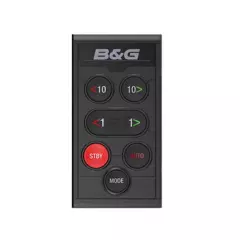
The built-in, intuitive keypad can be combined with the Triton2 instrument display to create a fully featured autopilot controller.
- Autopilot control unit
- Networkable, NMEA2000
- Compatible with B&G and Simrad

Campaign
Lowrance remote control
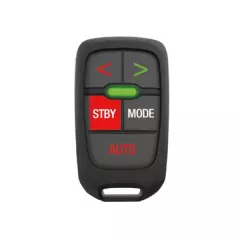
The WR10, which works with Lowrance autopilot systems, allows for precise heading changes and autopilot control from anywhere on the boat. Long-range Bluetooth technology provides a range of up to 30 meters. You can connect up to four compact and lightweight remote controls to a single BT1 base station (sold separately).
The WR10 has just five simple buttons that make autopilot control intuitive. Control or adjust the autopilot heading precisely in 1 degree increments or quickly in 10 degree increments. Easily switch to autopilot to navigate to the next waypoint on your current route. The anti-drift feature automatically maintains your current heading. With separate standby and engagement buttons, you can be sure that your autopilot is engaged or disengaged with the push of a button – even if you don’t know the autopilot’s current state. The WR10’s multi-color LEDs let you know when the autopilot has received a command, and a low battery message appears on the display, so you’re always up to date.
Easy to carry around
A remote control is only useful if you have it in your hand. The compact and lightweight WR10 has been designed with this in mind: the included strap offers a variety of mounting options, and a wristband makes using the WR10 even faster and easier. Despite its compact size, the WR10 has buttons that are as large as possible, so you can use it with any finger and in any conditions.
Easy to install
You can easily upgrade your WR10 to any compatible Simrad autopilot system yourself. Up to four remote controls can be connected to a single BT1 base station (sold separately), allowing multiple crew members to remotely control the autopilot.
- Easy to use and install
- Compact and lightweight remote control with large buttons
- Steering or steering setting in 1° and 10° increments
- Separate autopilot standby and engagement buttons
- Wrist or lanyard attachment
- Up to 30 meters range
- Intended for use with BT1 base station (sold separately)