Fuel tanks
A comprehensive selection of boat fuel tanks, jerry cans and containers.Product groups
Fuel tanks group products

Campaign
Built-in fuel gauge. Also equipped with a dipstick attached to the cap. Strong cap with air screw. Extra recess in the bottom for a spare tank. UV-resistant, red polyethylene. Equipped with a 1/4' NPT female threaded connection for a fuel connector.
- Capacity: 12 liters
- Length: 362mm
- Width: 260mm
- Height: 228mm


UV-resistant, red polyethylene. Strong cap with air screw. Extra recess in the bottom for a spare tank. Equipped with a 1/4' NPT female threaded connection for a fuel connector.
• Volume: 22.7 liters
• Length: 520mm
• Width: 330mm
• Height: 254mm
• Length: 520mm
• Width: 330mm
• Height: 254mm

Campaign
Built-in fuel gauge. Also equipped with a dipstick built into the tank cap. Strong lid with air screw. Extra pocket in the bottom that serves as a spare tank. UV-resistant, red polyethylene. Equipped with a 1/4' NPT female threaded connection for an adapter or hose according to the engine brand.
- Volume: 25L
- Length: 546mm
- Width: 355mm
- Height: 225mm
- Built-in meter
- Dipstick integrated into the tank cap
- UV-resistant
- Material: red polyethylene
- Manufacturer: Scepter

Campaign
Duramax helps you carry larger amounts of fuel more easily (53 liters). Duramax is a convenient way to refuel. The fuel pump handle with 3 meters of hose reduces the risk of overflow and spillage.
- Made of polyethylene, with UV-stabilizing additives.
- Built-in mechanical venting in the ergonomically designed tank cap.
- Stable 6-inch wheels improve mobility.
- The ergonomic design and durable handle make it easy to carry.
- Meets DOT and UN requirements for transporting liquids.
- Fuel pump with handle
- Volume 53 liters
- For gasoline
- Dimensions 860x400x350mm

Suzuki original fuel tank without fuel gauge for DF4/5/6 horsepower outboards. You can find a compatible fuel hose with ready-made connectors in the compatible products.
- Length: 36cm
- Width: 26cm
- Height: 23cm
- Capacity: 12 liters
- No fuel gauge


Suzuki original fuel tank without fuel gauge for DF4/5/6 horsepower outboards. You can find a compatible fuel hose with ready-made connectors in the accessories section.
- Length: 36cm
- Width: 26cm
- Height: 23cm
- Capacity: 12 liters
- No fuel gauge

Suzuki's original fuel tank. Capacity 25 liters. The tank has a carrying handle and a fuel gauge on the fuel tank cap.
- Length: 54cm
- Height: 23cm
- Width: 36cm
- Capacity: 25 liters
- Fuel gauge in the cap
- Carrying handle

Campaign
High-quality Quicksilver 12 liter fuel tank, intended for use with Mercury outboards and suitable for Mercury engine fuel hose connectors.
- Equipped with a “protected” quick connector
- Manually operated make-up air valve
- Fixed fuel gauge
- Intended for use with double-sealed fuel connector
- Capacity: 12 liters
- Size: 368mm x 248mm x 229mm


High-quality Quicksilver 25 liter fuel tank, intended for use with Mercury outboards and suitable for Mercury engine fuel hose connectors.
- Equipped with a “protected” quick connector
- Manually operated make-up air valve
- Fixed fuel gauge
- Intended for use with double-sealed fuel connector
- Capacity: 25 liters
- Size: 480mm x 318mm x 286mm
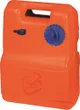
Strong plastic fuel tank. Equipped with air screw and fuel connection. The design of the tank makes it comfortable to carry. Indicator on the side.
• Capacity: 12 liters
• Width: 280mm
• Depth: 170mm
• Height: 400mm
• Width: 280mm
• Depth: 170mm
• Height: 400mm


Campaign
CE-approved plastic fuel tank for permanent installation, suitable for both petrol and diesel. The tank has an inspection hatch where a WEMA fuel sensor can be installed.
Sensors, meters and hose connector set are sold separately.
Available in the following sizes:
SEE - Fuel and water tank sensor Wema S5 0-190
SEE - WEMA fuel gauge for S3/S5 sensors
Sensors, meters and hose connector set are sold separately.
Available in the following sizes:
- 43L – size: 65 × 35 × 23+3 cm, compatible sensor 200mm
- 53L – size: 80 × 35 × 23+3 cm, compatible sensor 225mm.
- 70L – size: 80 × 40 × 28+3 cm, compatible sensor 275mm.
- 84L – size: 95 × 40 × 28+3 cm, compatible sensor 275mm.
- 96L – size: 110 × 40 × 28+3 cm, compatible sensor 275mm.
- (+3 cm is the inspection hatch)
SEE - Fuel and water tank sensor Wema S5 0-190
SEE - WEMA fuel gauge for S3/S5 sensors


Campaign
Made of stainless steel. Comes with a solid cover that can be replaced with a fuel gauge. Pre-installed inspection hatch with 1 1/2" threaded filler connection and cover. Ready for fuel gauge and return pipe (diesel).
Connections
- Suction hose: 10mm
- Vent: 16mm
- Stainless steel
- Volume 49L
- Dimensions 700x355x245mm (L x W x H)

Campaign
Made of stainless steel. Includes a closed cover where a sensor for the meter can be installed. Pre-installed inspection hatch with 1 1/2" threaded filler connection and cover. Ready for fuel gauge and return pipe (diesel).
Connections
- Suction hose: 10mm
- Vent: 16mm
- Stainless steel
- Volume 63L
- Dimensions 900x355x245 (LxWxH)

Fuel tank, UV-resistant polyethylene.
• Capacity: 5 liters

Fuel tank, UV-resistant polyethylene.
- Capacity: 10 liters
- High-quality Scepter tank
- UV-resistant material

Jerry can made of durable polyethylene. Stainless. Unique military design is narrower, making it easy to store in smaller spaces.
• Easy to use
• In the pipe, a replacement air pipe
• Compact design for easy storage
• Sturdy structure
• The tube is stored inside the container (with the cap on) when not in use.
• Easy to use
• In the pipe, a replacement air pipe
• Compact design for easy storage
• Sturdy structure
• The tube is stored inside the container (with the cap on) when not in use.
- Capacity: 20 liters
- Height: 47cm
- Width: 19cm
- Depth: 33cm

Fuel tank made of UV-resistant polyethylene.
- Capacity: 25 liters
- UV-resistant material

Fuel can for diesel, made of UV-resistant polyethylene.
• Capacity: 20 liters

Scepter fuel tank cap.
• Tank cap for product 2705-07

Suzuki fuel tank cap. For Suzuki DF4/5 engines. Part number: 65510-91J02-000
- Manufacturer's part number 65510-91J02-000
- Compatible: DF4, DF5
- Check the serial number to see if it is suitable.


