Life Jackets – The Most Important Safety Equipment on a Boat
Life jackets are by far the most important safety equipment for anyone on the water.
It is estimated that around eight out of ten drowning victims could have been saved if they had been wearing properly fitted life jackets. The law requires that life jackets are carried on board. On motorboats and sailboats over 5 metres in length, there must be a correctly sized life jacket or buoyancy aid for every person on board.
Products that we commonly call “life jackets” can actually be divided into several classes/standards. There are two main groups: life jackets and buoyancy aids. Below is an explanation of what separates these groups.
LIFE JACKETS
Automatic inflatable life jackets (also called “inflatable life jackets” or “gas life jackets”) when uninflated and inflated.
Life jackets are designed to save lives when a person ends up in the water. They provide buoyancy in a way that keeps the person in the correct position and will turn an unconscious person from face down to face up. They are designed to turn the wearer into an upright position and keep the airways well above the surface, even if the person is unconscious or unable to swim.
Life jackets are available as automatic inflatable models or traditional foam-filled models. What they all have in common is that, in the water, most of the buoyant material is located high on the body. A supportive collar holds the head above the water and keeps the face out of the water. A proper life jacket is the obvious choice for people who cannot swim well or whenever maximum safety and rescue capability are required.
The buoyancy of life jackets is always at least 100N. Inflatable models are divided into different classes depending on the conditions in which they are intended to be used. An automatic life jacket inflates when the wearer falls into the water, while a manual life jacket must be activated by the user.
Always check and adjust the straps every time the life jacket is put on. The amount of clothing under the life jacket changes how the straps need to be set. If several people use the same life jacket, it will always be adjusted for the previous user and must be readjusted for the next.
BUOYANCY AIDS (50N)
50N buoyancy aids are available for many different activities.
Vests with a buoyancy rating of 50 Newtons are often called sailing vests, boat vests or buoyancy aids. They are simpler than true life jackets. A 50N vest will keep you afloat in a relatively upright position, but it has no collar to support the head. Buoyancy is distributed more evenly front and back, so it does not guarantee that an unconscious person will turn face up in the water.
For this reason, 50N buoyancy aids are recommended only for swimmers weighing at least 25 kg.
CHOOSING A LIFE JACKET
How do you choose the right life jacket for yourself or for a child?
An ergonomically well-designed life jacket is comfortable to wear even for long periods. Brands such as Baltic and Spinlock put a lot of focus on comfort and fit so that life jackets are easy and pleasant to wear. This greatly increases the likelihood that people actually use them on the water and near shorelines. Marinekauppa offers a wide range of life jacket models, so you can choose a life jacket that suits you and your activity (sailing, motorboating, paddling, SUP boarding, etc.).
Because life jackets have a lot of buoyant material on the upper front part of the body, they can be awkward for swimming. For activities where you are often in the water, we recommend 50N buoyancy aids, for example:
-
light motorboating
-
rowing
-
paddling
-
other water sports where swimming is common
If there is any risk of rough conditions, offshore boating or ending up in the water far from shore and help, we strongly recommend 100N (or higher) life jackets.
Choosing Automatic Life Jackets
There is now a very wide selection of automatic inflatable life jackets, and they are used for everything from light day boating to ocean sailing.
The lightest models have no extra features; they are designed to be as light and comfortable as possible. Many have a soft fleece or similar material sewn into the neck to prevent chafing, especially when worn with a T-shirt.
Models designed for harsher conditions and sailing often include additional features such as:
-
sprayhood
-
light
-
integrated safety harness (for use with a safety line)
On many sailing models, the safety harness is built into the life jacket, so a safety line can be attached and a person in the water can be lifted using the life jacket.
Manual inflatable life jackets are intended for users who may get wet in normal use without wanting the jacket to inflate (for example paddlers or SUP boarders). It is important to remember that manual life jackets never inflate automatically and therefore do not protect an unconscious person who falls into the water.
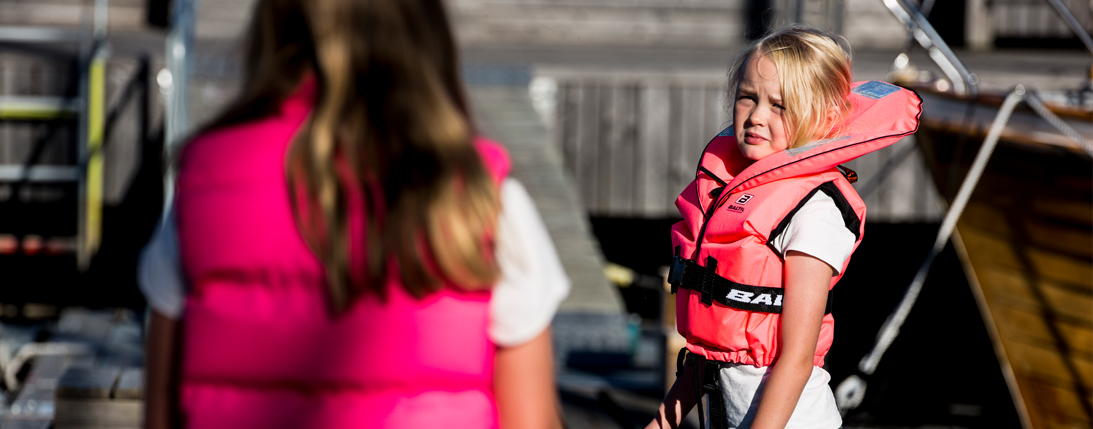
A common question is: from what age can children use inflatable life jackets? Many manufacturers specify a minimum weight of 40 kg. Lighter users must not use these jackets. Children’s lighter body build is not well suited to inflatable life jackets, and when they inflate, they can feel much tighter and more constricting than traditional life jackets. Children may also be frightened by the sudden inflation and loud noise.
Automatic life jackets require regular maintenance, and their condition should be checked several times during the season. More information about servicing inflatable life jackets can be found in our guide: Inflatable Life Jacket Maintenance – Marinekauppa.
When talking about automatic life jackets, we must also mention the importance of a crotch strap. This strap is now included in all automatic life jackets we sell. Using a crotch strap ensures that the life jacket stays correctly in place on a person in the water and does not ride up, which could allow the airways to slip below the surface. If you already own life jackets that do not have a crotch strap, you can buy one separately and retrofit it. See: Life Jacket Accessories.
Our recommendations in brief
-
Life jacket (traditional or inflatable) for sailing and motorboating, and for anyone who cannot swim.
-
50N buoyancy aid for all water sports where you are regularly in the water.
-
Children should always use 100N life jackets.
-
Only buy life jackets equipped with a crotch strap.
-
Choose jackets that feel comfortable to wear – then you are more likely to actually keep them on.
Buoyancy aids are also available for our four-legged friends.
CHOOSING THE RIGHT SIZE
A life jacket must fit properly. It should sit snugly and comfortably without sliding around. This is actually more important than the exact weight range printed on the label. Children should never use life jackets with “room to grow”.
When trying on a life jacket:
-
Make sure all zippers are closed, and all buckles are fastened and tightened properly.
-
Raise your arms straight above your head. Ask someone to gently pull up on the life jacket at the shoulders.
-
The life jacket must not slide up to your chin or face. It should stay close to the body, and there should be no gap between the shoulders and the top of the life jacket.
If the jacket moves too much, it is either too large or not properly adjusted.