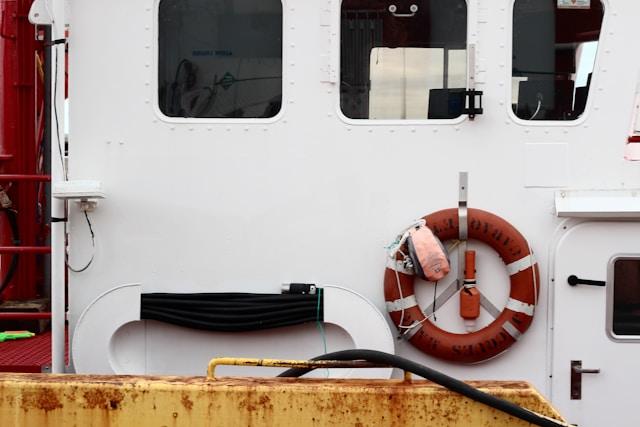
Why is fire safety especially important on a boat?
A boat fire is one of the most dangerous situations on the water. Unlike on land, a fire truck can't come to your aid offshore – your own equipment is the only initial firefighting option. Boat fires are most often caused by engine faults, fuel leaks, electrical system overheating, or errors in the galley. Older boats are especially at risk, as their gas, electrical, and heating systems age unnoticed.
A boat's enclosed structure makes detecting dangerous gases harder. Carbon monoxide is a colorless, odorless gas produced by incomplete combustion of fuel, for example when running a heater or engine. LPG is heavier than air and sinks to the bottom of the boat, where it can accumulate into an explosive mixture. That's why separate alarms for different hazards are essential.
Boat fire extinguishers – requirements and choice
The legal minimum rating for a boat extinguisher is 8A 68B, but in practice a minimum 2 kg ABC powder extinguisher rated 13A 89BC is recommended. This significantly exceeds the minimum requirement and is a cost-effective choice for most leisure boats. A registered boat requires a Class A extinguisher rated at least 13A.
Fire extinguishers suited to marine use carry MED approval (the wheel mark), meaning they meet the International Maritime Organization's (IMO) fire safety requirements and withstand the vibration, moisture, and temperature swings of marine conditions. The extinguisher should also carry CE marking and SFS-EN3 certification.
Extinguisher types for a boat
For the engine room, a separate automatic suppression system is recommended, such as a Salgromatic AeroMAG aerosol extinguisher, which triggers itself as temperature rises without any electrical connection. This is especially important, since an engine room fire can start without warning.
Placement of a boat's fire extinguisher
The extinguisher's location is critical: it must be easily accessible and quick to deploy in an emergency. An extinguisher in the wrong spot can be as useless as having no extinguisher at all.
The correct locations
On small and medium-sized leisure boats, it's worth placing one extinguisher near the helm, within the operator's reach. A second extinguisher is placed near the cabin entrance so it's reachable from both the deck and inside. On a boat with galley equipment, a fire blanket is placed on the wall next to the cooktop, in an easily removable bracket.
Keep these placement principles in mind:
The extinguisher must not be behind the escape route from a fire – you might have to pass the fire to reach it
Place the extinguisher somewhere visible, not hidden in a locker
Use a mount suited to the boat's motion that holds the extinguisher securely in place
Make sure other passengers also know where the extinguisher is
An automatic aerosol extinguisher is placed directly inside the engine room, as close as possible to ignition-risk items such as the fuel pump or electrical switches. A small extinguisher can be mounted directly inside the outboard's cowling.
A boat's smoke alarm
A smoke alarm is legally required equipment on every boat with sleeping accommodation. The alarm should be an ionization or photoelectric smoke detector that alerts early enough to prevent a fire from fully developing. A smoke alarm suited to marine use is water-resistant and vibration-resistant, since ordinary household smoke alarms aren't suited to a damp, vibrating boating environment.
Smoke alarm placement on a boat
The smoke alarm is placed on the cabin ceiling, as close as possible to sleeping areas and the galley. The optimal spot is the center of the ceiling, not directly next to a vent or hatch, since airflow can prevent smoke from reaching the sensor. Don't place the smoke alarm near the engine – exhaust fume residue can trigger false alarms.
A smoke alarm is mandatory equipment on boats with sleeping accommodation. On a larger boat, it's worth also getting a CO and gas alarm – carbon monoxide can be produced when running a heater, even without flames.
A boat's carbon monoxide alarm
A CO alarm detects carbon monoxide, a colorless, odorless, and highly toxic gas. CO is produced by incomplete combustion in engines, heaters, gas stoves, and other combustion appliances. A concentration of just 200 ppm can cause serious poisoning within 2–3 hours, and a concentration of 1,600 ppm is life-threatening.
A CO alarm isn't legally required equipment on a leisure boat in Finland, but it's practically essential on any boat where a heater is used or food is cooked in an enclosed space. According to the Finnish Lifeboat Institution, CO poisoning is one of the most common causes of boating accidents in Europe.
CO alarm placement
Carbon monoxide mixes evenly into air (its density is nearly the same as air's), so a CO alarm can be placed at breathing-zone height, 1–1.5 meters up on a wall, or on the cabin ceiling. The best spot is near the sleeping area, so the alarm wakes you at night. Don't place the alarm directly next to a gas stove or the engine's exhaust outlets.
A boat's gas alarm
A gas alarm detects leaks of LPG (propane, butane) and natural gas. LPG is heavier than air, so it sinks and collects at the bottom of the boat. This makes a gas leak especially dangerous on a boat – a small leak can fill the bilge area with an explosive mixture unnoticed.
A gas alarm is mandatory equipment if the boat uses LPG for heating or cooking. Even where the law doesn't always require it, an alarm is practically essential for safety.
Gas alarm placement – a critical detail
A gas alarm's placement differs significantly from other alarms, because LPG is heavy:
Place the gas alarm 15–30 cm above the floor, not on the ceiling
The alarm should be no more than 4 meters from the gas appliance
Not directly next to the gas appliance, but nearby
Install the sensor so the alarm can be heard from everywhere on the boat
Unlike an LPG alarm, a natural gas alarm is placed on the ceiling, since natural gas is lighter than air. A combination alarm that detects both LPG and carbon monoxide is placed at breathing-zone height as a compromise.
Alarm comparison table
Check out Marinekauppa's extensive range of alarms to find the right device for every need.
Fire extinguisher maintenance and inspection
A boat's fire extinguisher is exposed to more vibration, moisture, and temperature swings in use than a home extinguisher. That's why the law requires extinguishers used on boats to be inspected annually. The inspection confirms the extinguisher's operating condition, pressure level, and that the agent remains usable.
Checks you can do yourself during the season
In addition to the annual inspection, every boater can help maintain the extinguisher's condition:
Check the pressure gauge needle – it should point to the green zone
Regularly turn a powder extinguisher upside down and shake it – this prevents the powder from caking
Check the seal ring – if the seal is broken, the extinguisher must be inspected immediately
Clean the nozzle opening and make sure it's clear
Check the mounting bracket – the extinguisher must stay in place even in rough seas
A new extinguisher's factory final inspection is valid for 12 months. If you buy a new extinguisher, always check that the inspection sticker is less than a year old – otherwise the extinguisher needs a new inspection before use.
Testing and maintaining alarms
A smoke alarm should be tested weekly or at least monthly by pressing the test button. Smoke alarms should be replaced every 10 years, and the battery annually or when the unit gives a maintenance warning. Gas and CO alarms should be tested before every boating trip – use the test button or expose the sensor to test gas.
Emergency action – putting out a boat fire
In a boat fire, every second counts. Follow these steps:
1. Alert: Alert everyone else on the boat and make sure everyone has a life jacket on
2. Assess the situation: Can the fire be put out, or do you need to evacuate immediately?
3. Shut down the engine and close the fuel valve if possible
4. Use the extinguisher: Grab the extinguisher, pull the pin, aim at the base of the flames, and squeeze the lever in short bursts
5. Keep your escape route open: Never fight a fire with your back to your way out
6. Send a distress signal: Use VHF channel 16 or a Mayday call
If the fire has spread or is out of control, leave the boat immediately. Property can be replaced, a life can't. Read more in our guide to boat emergency equipment and survival at sea.
Boat fires that spread like wildfire leave little time to react. Abandoning ship into the water is the only option once a fire can no longer be brought under control.
What to do in a gas leak
If the gas alarm goes off on your boat, act calmly but quickly:
Immediately close the gas bottle or valve
Don't turn any electrical equipment on or off – a spark could ignite the leaked gas
Open all hatches, windows, and vents
Go out on deck for fresh air
Ventilate the boat thoroughly before going back inside
Have the gas system checked before using it again
Frequently asked questions – boat fire extinguishers and alarms
Is a fire extinguisher mandatory on every boat?
A fire extinguisher is legally required on any boat with an inboard engine or an outboard over 25 kW (about 34 hp). In addition, a flame-based combustion appliance, such as a heater with a gas stove, requires its own extinguisher. Small rowboats aren't required to carry one, but it's a recommended safety item.
How often does a boat's fire extinguisher need to be inspected?
Extinguishers in marine use must be inspected annually at an authorized service point. This is a legal requirement, since the marine environment stresses an extinguisher more than home use. The inspection's validity is shown on the sticker on the extinguisher.
Is one fire extinguisher enough for a boat?
One 2 kg extinguisher may be enough for a small boat, but on a larger boat at least two extinguishers in different locations are recommended. It's also worth getting an automatic suppression system for the engine room, which works without human intervention.
Where should the gas alarm be placed on a boat?
An LPG alarm is placed 15–30 cm above the floor, since LPG is heavier than air and collects at low points. A CO alarm, on the other hand, is placed at breathing-zone height or on the ceiling. A combination alarm is placed at breathing-zone height.
Can an ordinary household smoke alarm work on a boat?
An ordinary household smoke alarm isn't suitable for a boat, since it can't withstand the moisture and vibration of boating conditions. You need a water-resistant, vibration-resistant smoke alarm made specifically for marine use.
Get your boat's fire safety equipment from Marinekauppa
A boat's fire safety consists of the right equipment, correctly placed, and regularly maintained. Fire extinguishers and alarms are an investment that can save lives. Also remember other important safety equipment: life jackets for every passenger and the boat's emergency equipment, which should also cover a VHF radio and life rings.
Browse Marinekauppa's extensive safety equipment range and make sure your boat meets legal requirements and keeps its users safe before every outing on the water.
Sources and further reading
Traficom – Boating safety
SFS-EN 3-7 + A1: Portable fire extinguishers – Characteristics, performance requirements and test methods
ISO 9094:2022: Small craft — Fire protection
Extinguisher type | Suitability | Note | |||
ABC powder extinguisher (2 kg) | Most common for marine use; Class A, B, and C fires | Leaves a powder residue; requires annual inspection | |||
Automatic aerosol extinguisher | Engine rooms, outboard cowlings | Fully electricity-free; triggers automatically from heat | |||
Potassium aerosol extinguisher | General spaces; no powder residue | A clean option; no cleanup needed | |||
Fire blanket | Cooking area; small grease and electrical fires | Complements a hand extinguisher; not sufficient alone | |||
Alarm | Detects | Mounting height | Legally required? | ||
Smoke alarm | Smoke, flame | Ceiling | Yes (sleeping accommodation) | ||
CO alarm | Carbon monoxide | Breathing zone / ceiling | Recommended | ||
Gas alarm (LPG) | LPG, natural gas | 15–30 cm from floor | Recommended | ||
Combination alarm | CO + gas (+ smoke) | Breathing zone | Recommended compromise | ||
Disclaimer
This guide provides general guidance only and does not replace the product manufacturer's operating, installation, or service instructions. Marinekauppa is not responsible for actions taken based on this guide or their consequences. Always check product-specific instructions and consult a qualified professional if needed.


