Boat lighting is a package that splits into legally required navigation lights and optional comfort lighting. LED lights are today's superior choice for a boat thanks to their low power draw, long lifespan, and durability. Correctly designed lighting improves safety, adds comfort, and extends battery runtime on the water.
This guide covers every area of boat lighting: mandatory navigation lights, interior lighting, deck and exterior lights, and practical tips for installing LED lights and managing power consumption.
Image name: boat-lighting-solutions-led-lights
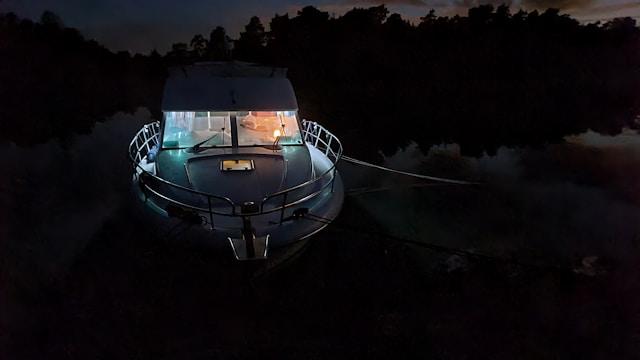
ALT text: A boat's interior and exterior LED lighting in evening use
What lighting solutions does a boat need?
Boat lighting consists of three main groups: navigation lights (running lights, anchor light), exterior lights (deck lights, work lights), and interior lights (cabin lighting, ambient lighting). Navigation lights are legally required; the others are chosen at the boater's discretion.
Why are LED lights the best choice for a boat?
LED lights' superiority over traditional halogen and incandescent bulbs is significant. Hella Marine NaviLED navigation lights' port and starboard lights together draw under 2 watts combined, compared with traditional halogen navigation lights, which typically drew 20–40 watts. That's a power saving of up to 90–95%.
LED technology's key advantages in marine use:
Long lifespan: Over 50,000 hours – effectively the whole life of the boat
Low power draw: Saves battery capacity significantly
Durability: No filament to break from vibration
High IP rating: Waterproof models (IP67–IP68) suit outdoor use
Instant-on: Full brightness immediately
Cool operating temperature: No overheating risk
LED technology has revolutionized boat lighting. Switching from halogen to LED can cut total lighting power consumption by 80–90%, which in practice means several extra hours of battery capacity on a trip.
A boat's navigation lights – legally required safety lighting
Navigation lights are a boat's most important lighting component. They're legally required and must meet IMO COLREG 72 standard requirements. Incorrect or missing navigation lights can lead to serious accidents when out on the water in darkness. Check out Marinekauppa's navigation lights.
Navigation light color-sector requirements
International maritime rules (COLREG) set exact requirements for navigation lights' colors, visibility angles, and range:
Red sidelight (port, left side): 112.5° sector, visibility at least 1 NM on boats under 12m
Green sidelight (starboard, right side): 112.5° sector, same requirement
White sternlight: 135° sector, visibility at least 2 NM
White masthead light (for motorboats): 225° sector, visibility at least 2 NM
On boats under 7 meters, a combined lantern covering all the sector requirements is sufficient. On motorboats under 12 meters, a single navigation light with colored sectors can be used instead of separate sidelights. On sailboats over 20 meters, lights must be installed separately per exact regulations.
Navigation lights with Traficom type approval are recommended for Finnish waters, since they're tested for Finnish conditions. You'll find suitable navigation lights and light masts at Marinekauppa.
Battery-powered navigation lights for small boats
For smaller boats, canoes, and rowboats, battery-powered navigation lights are a practical solution. Navisafe LED lights, for example, are visible from 2 nautical miles and work in several modes: as an anchor light, masthead light, sternlight, and general all-round light indicator. Runtime on one set of batteries is typically 15–85 hours depending on the mode of use.
Anchor lights – safety for overnight stays
An anchor light is mandatory whenever a boat is anchored or moored somewhere it could interfere with other traffic. An anchor light is a white 360° light that must be visible from all directions from at least 2 nautical miles away.
The anchor light's mounting location is the top of the mast or the boat's highest point, so it's visible from everywhere. The Hella NaviLED 360 anchor light draws under 1 watt, making it one of the most energy-efficient on the market, while still providing the USCG- and IMO COLREG-compliant 2 NM range.
Deck and exterior lights – safety for working on deck
Deck and exterior lights are optional but extremely useful. They improve safety when moving around the deck in the dark and make handling the anchor, ropework, and docking easier.
Types of deck lights and their uses
Work lights (flood lights): Wide, even lighting for the deck area – suited to lighting the anchor spot and ropework
Spot lights: Narrow-beam lights for specific targets, such as spotting buoys or shoreline rocks
Rail-mounted lights: Easy to install without drilling, suit rental boats and travelers
Recessed deck lights: Neat appearance, don't snag lines, IP67 or higher rating
Deck lights' IP rating is very important: at least IP65 protects against splashing water, IP67 withstands submersion to a meter for 30 minutes. For outdoor use, at least IP66 is recommended. The housing material should be corrosion-resistant: stainless steel, anodized aluminum, or UV-stabilized plastic are suitable choices for a salt-water environment.
A boat's interior lighting – comfort in the cabin
Interior lighting makes boating more comfortable, especially in the evenings and on overnight trips. Well-designed interior lighting combines general lighting, reading spot lights, and ambient lighting.
Ceiling and wall lights for general cabin lighting
Ceiling and wall lights are the cabin's basic fixtures. Modern LED interior lights, such as the Båtsystem Comet, draw just 2.4 watts while matching a 12-watt halogen bulb. Color temperature significantly affects mood: 2700–3000K produces a warm, homey light, while 4000–5000K creates a bright, more neutral light suited to navigation use.
Dual-color lights that switch between white and red are especially useful. Red light preserves night vision, which is why it's excellent for night navigation: your eyes stay adapted to the dark, so you can see better outside. The Hella Marine EuroLED 75 is a very popular model for this purpose.
LED strips for ambient lighting
LED strip lighting is a popular solution for a boat's interior. Strips can be installed under lockers, along table edges, or at the floor edge to create soft, indirect lighting. RGBW strips let you adjust color and brightness with a remote, and one remote can control several zones in different parts of the boat.
LED strips made for marine use are designed to withstand moisture and voltage fluctuations. Voltage swings in a boat's electrical system can be significant when the engine starts, which is why it's worth getting a voltage stabilizer for LED strip lighting to protect sensitive components.
Other interior lights for special purposes
Specialty fixtures are available for many needs: engine room lights make engine maintenance easier, reading lamps are ergonomic for long evenings, and dimmable lights allow flexible brightness adjustment to suit the situation.
LED light power consumption and battery planning
When planning lighting, it's key to understand total power draw relative to battery capacity. The calculation below illustrates a typical boat's lighting consumption overnight:
A 100Ah 12-volt battery holds 1,200 Wh of energy. At 57 Wh of consumption, lighting alone uses only about 5% of the battery overnight – considerably less than before LED technology, when the same lighting level would have used 400–600 Wh overnight.
It's worth getting familiar with your boat's overall electrical system design. You'll find more information on sizing a boat's electrical system in our boat electrical system guide, and on using solar power for lighting in our article on installing a solar panel on a boat.
Installing lights: practical instructions
Installing boat lights requires care. All installations should use tinned copper cable suited to marine use and salt-water-resistant connectors.
Navigation light installation checklist
Check that the lights are positioned according to COLREG requirements
Confirm sector angles – for example, the port (red) light must not be visible on the starboard side
Use at least IP67-rated lights for outdoor installations
Protect cables from UV radiation and moisture with conduit or channels
Install separate fuses for each light group (typically 1–3 A)
Test the lights before heading out, checking both visibility and correct sector
A note on IP ratings
The IP (Ingress Protection) rating indicates a fixture's protection level against moisture and dirt. The first digit (0–6) indicates dust protection, the second (0–9) water protection. For marine exterior lights, the minimum recommendation is IP65 (splash-protected), but IP67 (submersion to 1 meter, 30 minutes) or IP68 (continuous submersion) rated lights are more durable, especially in waves.
Boat lighting – frequently asked questions
What navigation lights does a boat under 7 meters need?
On a boat under 7 meters, the minimum requirement is a single white light or a combined lantern that covers COLREG's sector requirements. In practice, a combined navigation light or a 360° light mast that includes both the red and green sidelight sectors and the sternlight is recommended. A battery-powered navigation light suits the smallest craft.
Can a traditional halogen navigation light be replaced with LED?
Yes, but the swap requires care. LED bulbs must be COLREG-approved and type-approved for marine use. A simple bright LED bulb isn't enough if it doesn't meet the exact sector-angle and range requirements. The safest approach is to get an entirely new LED navigation light already approved by the manufacturer to the standards.
Are there special requirements for a boat's interior lights?
There are no legal requirements for interior lights. Practical recommendations are: use 12V DC fixtures suited to the boat's electrical system, choose at least IP44-rated lights for damp spaces (washrooms, engine room), and consider night-vision-preserving red lights for navigation.
How much less battery do LED lights use compared with halogen?
LED lights typically use 80–95% less than halogen bulbs of comparable brightness. For example, a 20-watt halogen sidelight is replaced by a 1–2 watt LED light. On an overnight trip, that means tens of amp-hours saved – which can be the deciding factor when anchored out without a generator or shore power.
Do boat lighting products need to be marine-approved?
Navigation lights must be approved – IMO COLREG 72, USCG, or Traficom type approval is a requirement for use in Finnish waters. Interior and deck lights have no mandatory approvals, but products designed for marine use have significantly better characteristics (corrosion resistance, tolerance to voltage swings, IP rating) than ordinary household lighting products.
Get your boat lighting from Marinekauppa
Quality LED lights are an investment that pays for itself in saved battery energy and long service life. In Marinekauppa's extensive range you'll find everything you need: navigation lights, anchor lights, deck and exterior lights, and interior cabin lights. Also check out our full range of boat lights and lighting.
Need help choosing the right lighting? Our knowledgeable staff are happy to help – browse the range and order easily from our webshop!
Sources and further reading
Maritime law and boating regulations – Finlex
Traficom – Boating safety regulations
Light group | Purpose | Mandatory? | Typical power (LED) |
Navigation lights (side, stern, masthead) | Showing heading to others | Yes (COLREG) | 1–3 W / light |
Anchor light (360°) | Signaling visibility when anchored | Yes, when anchored | 0.5–2 W |
Deck / exterior lights | Work lighting on deck | No | 3–10 W |
Interior lights (ceiling, wall) | General cabin lighting | No | 1–5 W |
LED strips / ambient lighting | Comfort and atmosphere | No | 4–10 W / meter |
Fixture | Power (LED) | Runtime (h) | Energy use (Wh) |
Navigation lights (3) | 5 W total | 4 h | 20 Wh |
Anchor light | 1 W | 8 h | 8 Wh |
Cabin interior lights | 8 W total | 3 h | 24 Wh |
Deck light | 5 W | 1 h | 5 Wh |
Total | 57 Wh |
Disclaimer
This guide provides general guidance only and does not replace the product manufacturer's operating, installation, or service instructions. Marinekauppa is not responsible for actions taken based on this guide or their consequences. Always check product-specific instructions and consult a qualified professional if needed.