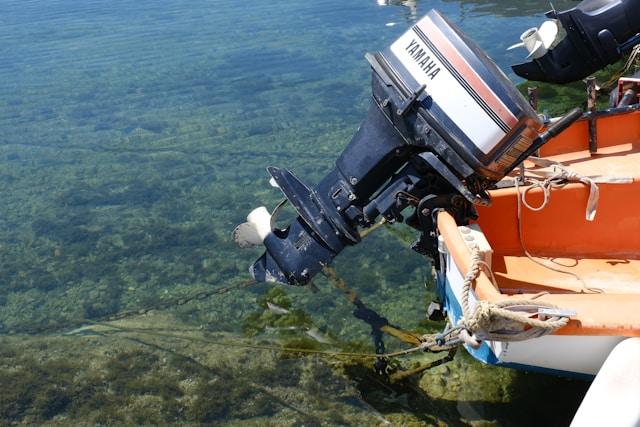
Choosing the right propeller is one of the decisions with the biggest impact on your boat's performance. The wrong prop overloads the engine, wastes fuel, and slows the boat – the right one, on the other hand, unlocks the engine's full power, improves acceleration, and can cut consumption by up to 15–20%. This guide covers how to choose an outboard propeller by pitch and diameter, the material differences between aluminum and stainless steel, and how to replace an outboard propeller correctly, step by step.
What is a boat propeller and how does it work?
A boat's propeller is the last link in the drivetrain: it converts the engine's rotational motion into forward thrust. A propeller consists of blades (2–5), a hub, and a shaft connection. The blades cut through the water in a wave-like motion, and with every rotation the propeller theoretically advances a certain distance – this is called pitch.
Three main dimensions affect a propeller's efficiency: diameter, pitch, and number of blades. When these are balanced with the engine's power and the boat's weight, the engine spins in its manufacturer-recommended RPM range (usually 5,000–6,000 rpm at full throttle) without being overloaded.
Image name: choosing-and-replacing-an-outboard-propeller
ALT text: Choosing and replacing a boat propeller on an outboard for the right performance
What do propeller pitch and diameter mean?
Pitch
A propeller's pitch is given in inches and indicates how far the propeller theoretically advances in one full rotation without slip. For example, a 19-inch pitch means the propeller would move 19 inches (about 48 cm) forward in one rotation in a frictionless medium. In practice, slip is 10–15%.
Pitch directly affects engine load and boat speed: a larger pitch gives more top speed but needs more torque and can drop RPM too low. A smaller pitch accelerates faster and suits heavy loads, but limits top speed.
Pitch too large: The engine doesn't reach the recommended RPM range at full throttle → overload, overheating, premature wear
Pitch too small: The engine exceeds recommended RPM → inefficient, excessive fuel consumption
Correct pitch: The engine spins between 5,000–6,000 rpm at full throttle (check your engine's manual)
Diameter
Diameter indicates the diameter of the circle the propeller traces as it spins. A larger diameter moves more water and suits slower or heavier boats; a smaller diameter suits faster, lighter craft. On most outboards, diameter is pre-set by the gearcase size, and the more significant variable in your choice is pitch.
How do I choose the right propeller for my outboard?
A practical test is used to choose a propeller: install the prop, run at full throttle with a normal load on calm water, and measure RPM. A correctly chosen propeller puts the engine in the upper half of its RPM range (e.g., 5,200–5,800 rpm) if the recommended range is 5,000–6,000 rpm.
If RPM falls below the recommendation, switch to a smaller-pitch prop (1–2 inches less). If RPM exceeds the recommendation, switch to a larger-pitch prop (1–2 inches more). One inch of pitch corresponds to roughly a 150–200 rpm change.
Factors affecting propeller choice
In practice, most manufacturers (Yamaha, Mercury, Suzuki, Honda) ship a new engine with a standard propeller suited to typical boating use. If your boating style or load differs clearly from the standard case, optimizing the propeller can make a significant difference.
One of the most common mistakes is choosing too large a pitch to make the boat go faster. The result is often the opposite: the engine doesn't reach full power, acceleration suffers, and consumption rises.
Aluminum or stainless steel – which propeller material?
Propellers are made mainly of aluminum or stainless steel, and the choice significantly affects performance, durability, and price.
An aluminum propeller is the right choice for most Finnish hobbyists, especially in the shallow areas of the Finnish archipelago, where the propeller can occasionally hit bottom. Aluminum "gives way" when it hits a hard obstacle, protecting the gearcase and engine from costly damage. Stainless steel, on the other hand, is worth considering if you run offshore or want to maximize performance.
Three- or four-blade propeller?
The number of blades significantly affects a propeller's characteristics, and the choice depends on intended use. A three-blade propeller is the most common and offers a good balance between speed and efficiency. It's effective for straight-line running and general use.
A four-blade propeller offers better acceleration, smoother running, and less vibration, especially on heavily loaded boats or for watersports use. A four-blade prop also holds better in the water during a sharp turn. The downside is a slightly lower top speed and a higher price compared with three blades.
Replacing an outboard propeller – a step-by-step guide
Replacing an outboard propeller is a simple task a more experienced boater can do themselves. You'll need: a new propeller, a prop nut wrench or a suitable socket wrench, waterproof grease (e.g., Mercury 2-4-C Marine Grease), and possibly a propeller puller tool.
Step 1: Shut off the engine and disconnect power
Always make sure the engine is fully shut off and the ignition key removed before touching the propeller. Tilt the engine down so the propeller is easier to reach.
Step 2: Remove the cotter pin nut
The propeller is secured to the shaft with a cotter pin or a nut. First remove any protective rubber cap or cover over the cotter pin. Remove the cotter pin's retaining nut counterclockwise. Some models need a shaft-lock tool to loosen the nut.
Step 3: Pull the propeller off the shaft
The propeller usually comes off by pulling straight out. If it's stuck, use a propeller puller tool or a soft mallet with a protective cap – never strike metal directly on metal. At the same time, check the shaft's condition: are the splines intact, is there any wrapped fishing line or debris?
Step 4: Clean and grease the shaft
Clean the propeller shaft mechanically (with a steel brush if needed) of salt residue and corrosion. Apply waterproof grease to the shaft splines – this prevents the propeller from seizing and makes the next replacement easier. Don't apply too much grease, since it can clog the shaft's water passage holes.
Step 5: Install the new propeller
Slide the new propeller onto the shaft. Make sure the blade rotation direction is correct (right-hand rotation on most outboards). Push the propeller fully onto the shaft.
Step 6: Tighten the nut and install the cotter pins
Tighten the prop nut to the manufacturer's torque spec (typically 30–50 Nm). Reinstall the cotter pin or wire so the nut can't loosen while underway. Check that the propeller spins freely by hand and has no play.
Step 7: Test on the water
Start the engine first with flush muffs on land and check for unusual noise or vibration. On the first run on the water, monitor performance especially closely.
Signs the propeller is wrong or damaged
The following symptoms indicate the propeller is worth checking or replacing:
The engine doesn't reach the recommended RPM range at full throttle – pitch is likely too large
Unusual vibration while underway – the propeller is bent or out of balance
Fuel consumption has risen noticeably – the propeller is worn or damaged
The boat is slower than before – the blades are damaged or material is wrapped around the shaft
Poor acceleration or the boat won't get a water-skier up on plane – pitch is likely too large or the blade count is wrong
Always inspect the propeller after the boat has hit bottom or run over a sandbar. Small-looking dents and bends can significantly reduce performance and increase vibration, which stresses the gearbox and bearings over the long term. You'll find more information on outboard maintenance in our outboard service guide.
Frequently asked questions: choosing a propeller
How do I know which propeller suits my outboard?
Check the manufacturer's recommended full-throttle RPM range (e.g., 5,000–6,000 rpm). Install the propeller, run at full throttle with a normal load, and measure RPM. If you're below the recommendation, choose a smaller pitch; if you're above it, choose a larger pitch.
Can I replace my outboard's propeller myself?
Yes, replacing an outboard propeller is a simple task most boaters can do at home with the right tools. The key is making sure the engine is off, the shaft is clean and greased, and the nut is correctly tightened with the cotter pin.
What's the difference between an OEM and an aftermarket propeller?
OEM propellers are manufactured precisely for a given engine brand and guarantee the manufacturer's warranty. Aftermarket propellers (e.g., Quicksilver, Michigan, Polaris) can be more affordable and offer compatibility across multiple brands, but it's worth checking fitment before buying. Quality aftermarket propellers often match OEM performance.
Does the propeller need to be replaced every year?
No, the propeller doesn't need annual replacement. It's checked for damage during fall service. Replacement is needed when the propeller has dents, bends, or wear causing vibration, or when performance has degraded after hitting bottom.
Find the right propeller at Marinekauppa
In Marinekauppa's extensive range you'll find propellers for all the most common outboards – Yamaha, Mercury, Suzuki, and Honda. Our range includes both OEM propellers and quality aftermarket brands like Quicksilver, Michigan, and Polaris.
Browse propellers by brand easily:
Yamaha propellers
Mercury propellers
Suzuki propellers
Honda propellers
Other propellers and aftermarket props
If you're unsure which propeller suits you, contact Marinekauppa's experts – tell us your engine brand, power, and typical use, and we'll help you find the best option.
Sources
Mercury Marine – Prop Diameter & Pitch (Dockline)
Mercury Marine – How to Swap Your Prop
Mercury Marine – Mercury Propeller Selector Tool
Factor | Effect on propeller choice | ||
Boat weight and length | Heavy/long boat → smaller pitch, more blades | ||
Engine power (hp) | More power → larger pitch possible | ||
Intended use | Watersports/acceleration → small pitch; speed/offshore → large pitch | ||
Typical load | Full load → smaller pitch vs. running solo → larger pitch | ||
Engine type | Check the manufacturer's recommended RPM range | ||
Feature | Aluminum | Stainless steel | |
Price | Affordable (€40–150) | More expensive (€150–500) | |
Weight | Light | About 40% heavier | |
Durability | Damages more easily on impact | Very durable | |
Performance | Good for basic use | Better acceleration and speed | |
Blade thickness | Thicker blades | Thinner, more efficient blades | |
Suits | Recreational use, shallow areas | Demanding use, offshore, racing | |
Disclaimer
This guide provides general guidance only and does not replace the product manufacturer's operating, installation, or service instructions. Marinekauppa is not responsible for actions taken based on this guide or their consequences. Always check product-specific instructions and consult a qualified professional if needed.