How Inflatable Life Jackets (Automatic Life Jackets) Work
Inflatable life jackets contain either an automatic or manual inflation mechanism connected to an airtight bladder.
-
Manual activation: Pull the cord located on the right side of the life jacket. A sharp tug triggers the mechanism, and the air bladder inflates immediately.
-
Automatic activation: The life jacket inflates within about three seconds after being submerged in water.
Automatic jackets can also always be inflated manually. Both types can also be inflated orally using the inflation tube, which is also used to deflate the life jacket.
Important: After gas inflation, inflatable life jackets must be serviced. Inside the life jacket, you will find instructions indicating which re-arming kit your model uses.
Service life: Automatic life jackets have a recommended maximum lifespan of 10 years. Over time, materials may weaken and may no longer withstand automatic inflation without tearing.
SEE MARINEKAUPPA’S AUTOMATIC LIFE JACKETS
SEE SPARE PARTS FOR LIFE JACKETS
Components of an Automatic Life Jacket
(CO₂ cylinder + trigger mechanism. The black “salt cartridge” is the automatic trigger.)
The Importance of Annual Inspection
Inflatable life jackets require inspection whether they have been activated or not. You can do a basic pre-use check yourself (instructions below), but skipping the annual inspection may cause malfunction and pose a life-threatening risk. You may perform a simplified inspection yourself or bring the jacket to an authorized service center.
Before every use, check the following:
1. Check the CO₂ Cylinder
Unscrew the cylinder counterclockwise and confirm it has not been punctured.
If it is punctured, it is empty and must be replaced.
Screw the unopened cylinder back on firmly by hand.
2. Check the Indicators and Trigger Mechanism
For automatic versions:
-
Check both safety indicators.
-
If either of the green indicators is missing and/or the cylinder is punctured, the life jacket must be serviced.
-
Check that the trigger mechanism’s expiry date has not passed.
For manual versions:
-
Check the safety indicator.
-
If it is missing, the cylinder is empty and must be replaced.
Note: Safety indicators do not determine the expiry date for the cylinder or trigger unit. Always follow the manufacturer's printed expiry dates.
3. Check the Pull Cord
Ensure the manual pull handle is visible and accessible when the life jacket is worn.
ANNUAL MAINTENANCE OF INFLATABLE LIFE JACKETS
Inflatable life jackets require regular annual inspections, even if they have never been activated. Failure to do so may result in malfunction. Follow the steps below or have the jacket serviced professionally.
Replacing the Cylinder and Trigger After Inflation
If your life jacket has inflated automatically:
-
Remove both the CO₂ cylinder and the trigger mechanism.
-
Install a new trigger and check that its expiry date is valid.
-
Install a new, unopened CO₂ cylinder.
If the jacket was inflated manually:
-
Only the CO₂ cylinder must be replaced.
-
Install the green safety clip over the manual lever.
-
If the indicator window shows red, the cylinder must be replaced and the lever reset until you hear a click.
For jackets with Pro Sensor MK2 / Pro Sensor Elite:
Both indicator windows must show green after installing a new cylinder and trigger.
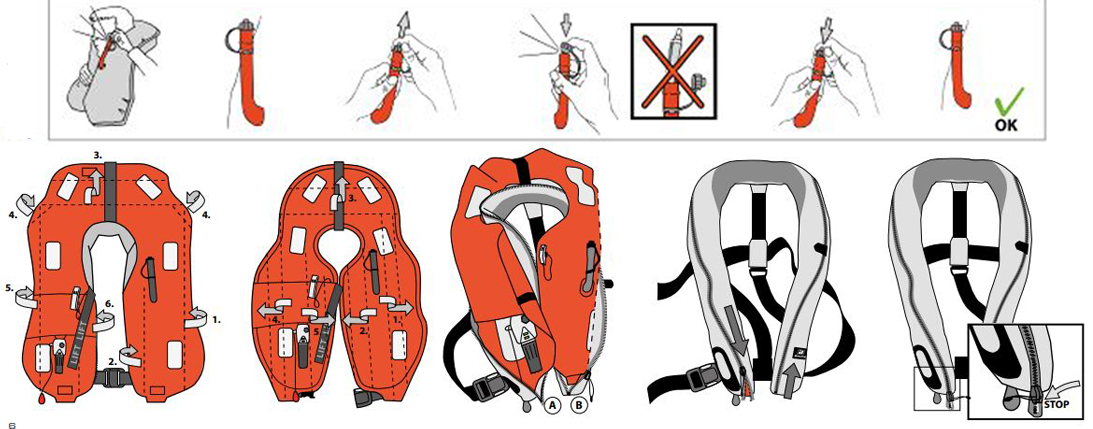
Checking the Trigger, Deflating the Jacket and Repacking
-
Pull the zipper slider only onto zipper chain A.
-
Move the slider around the entire life jacket to the underside, to point B.
-
Attach the puller to the zipper and close the jacket all around.
-
Stop before the final stopper — do not pull the slider past the end of the chain.
Fold the hook-and-loop flaps back into place and tuck the zipper end inside the jacket cover.
Expiry Dates of Cartridges
-
United Moulders triggers: Marked with month and year (e.g. 09 2022 = replace by September 2022).
-
Halkey Roberts cartridges: Marked with production month/day/year.
-
Maximum service life: 4 years.
-
In leisure boating: replace no later than the third season after first use.
-