A boat's mandatory equipment is determined by the Water Traffic Act (782/2019) and Traficom's equipment requirements. In brief: every motorboat and sailboat over 5 meters must have life jackets for everyone aboard, a bilge pump or bailer, and oars, a paddle, or an anchor with line. A rowboat's equipment requirements are considerably lighter, since the law only adds requirements once an engine or certain equipment is involved.
This guide covers the legal requirements by boat type, explaining what the law requires and what a more experienced skipper recommends beyond the minimum equipment. The skipper's responsibility is unambiguous: under the Water Traffic Act, the vessel's skipper is responsible for ensuring equipment is in order and easily accessible before heading out on the water.
What equipment does the law require on a boat?
A boat's mandatory equipment and its scope depend on three factors: whether the vessel has an engine, its length, and what kind of equipment is on board. Traficom's basic requirement applies to all motorized boats and sailboats over 5 meters. For the smallest rowboats and canoes, requirements are lighter, but life jackets are always a mandatory basis for safe boating.
A boat must always have approved, correctly sized life jackets, survival suits, or other flotation garments for everyone on board, easily accessible. In addition, a motorboat or a sailboat over 5 meters must have a bilge pump or bailer, and oars, a paddle, or an anchor with line.
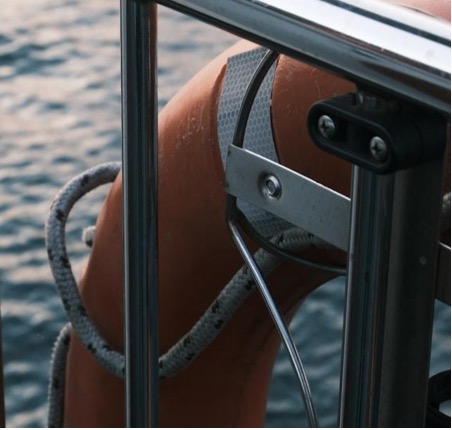
Image name: mandatory-boat-equipment-rowboat-motorboat-sailboat
ALT text: Mandatory boat equipment for a rowboat, motorboat, and sailboat for safe boating
A rowboat's mandatory equipment
A rowboat's mandatory equipment is the lightest from a legal standpoint. Without an engine, rowing doesn't require an extinguisher, a bilge pump, or an anchor. In practice, though, the following are required:
Life jackets for everyone on deck, CE-marked and correctly sized
A sound-signaling device, such as a whistle or horn (on vessels under 12 meters, a device capable of a loud sound signal is enough)
Navigation lights, if the boat is out in darkness or poor visibility (per COLREG rules)
Although the law doesn't require more for a rowboat, it's recommended to carry a bailer for removing water, plus a line for possible towing. Battery-powered navigation lights, which are light and easy to install, suit rowboats excellently. When rowing, it's vital to remember life jackets.
A motorboat's mandatory equipment
A motorboat's mandatory equipment is more extensive than a rowboat's, since the engine brings both higher speeds and a fire risk. Under the Water Traffic Act, every motorboat must have at least:
Life jackets or flotation garments for every passenger
A bilge pump or other bailing device (e.g., a bailer)
Oars, a paddle, or an anchor with line, appropriate to the vessel's size
A hand-held fire extinguisher, annually inspected, if the vessel has an inboard engine, an outboard over 25 kW (about 34 hp), or a flame-fired combustion appliance
A sound-signaling device for a loud sound signal (boats under 12 m), a fog horn (over 12 m), a ship's bell (over 20 m)
Navigation lights per COLREG collision regulations
The extinguisher requirement is one of the most common equipment mistakes found in inspections. The extinguisher's rating must be at least 8A 68B, but in practice a 2kg ABC powder extinguisher rated 13A 89BC is recommended. The extinguisher must be inspected at an authorized service point annually, and the inspection date is shown on the extinguisher's label. Read more about choosing an extinguisher in our fire extinguisher range.
Equipment must also include a nautical chart, if the trip's length or conditions require route planning. The chart must be published by the nautical charting authority and up to date.
A sailboat's mandatory equipment
A sailboat's mandatory equipment follows the same basic requirements as a motorboat once the vessel's length exceeds 5 meters. A sailboat under 5 meters is treated like a rowboat for equipment purposes. Sailboats over 5 meters require life jackets for everyone, a bilge pump or bailer, oars, a paddle, or an anchor with line, and a sound-signaling device.
A fire extinguisher is mandatory while sailing if the boat has an inboard engine, an auxiliary motor over 25 kW, or a flame-fired combustion appliance, such as a pantry with a gas stove. A smoke alarm is mandatory on a sailboat with sleeping accommodation.
Equipment requirements for vessels in competitive sailing are considerably stricter and are determined by inspection class. Check out inspection equipment by class at Marinekauppa.
Equipment by boat type – comparison table
* Extinguisher mandatory if the vessel has an inboard engine, an outboard over 25 kW, or a flame-fired combustion appliance.
Recommended equipment beyond the legal minimum
Legal requirements are minimum requirements. Safe boating, in practice, calls for more extensive equipment, and an experienced boater always prepares for changing conditions. The following equipment is recommended regardless of boat type:
A VHF radio is the most important communication device in an emergency. Using it requires a VHF radio operator certificate and a ship radio license from Traficom.
Emergency signaling equipment, such as LED flares and red hand flares, matter especially in the archipelago and along the coast.
CO and gas alarms protect against life-threatening gases when a heater, cooker, or engine is used in enclosed spaces.
An emergency beacon (EPIRB or PLB) sends an automatic distress signal to the maritime rescue center and is especially important on long trips.
A life raft is a serious safety investment for offshore trips and long passages.
An MOB rescue system significantly speeds up rescue in a man-overboard situation.
A first aid kit and a waterproof flashlight are worth always having on board.
The mandatory equipment list is short, but it's an absolute minimum. An experienced boater knows that anything can happen on the water, and every extra piece of equipment improves your chances of getting through unexpected situations.
Choosing life jackets for different boat types
Life jackets are the only piece of equipment mandatory on every vessel, regardless of boat type. Buoyancy is measured in newtons (N), and the right buoyancy class depends on the environment of use. On inland waters, 100N buoyancy aids are enough for a competent adult swimmer, but on the coast and offshore, at least 150N auto-inflating jackets that fill automatically when entering the water are recommended.
For children's life jackets, what matters most is the jacket's ability to turn the child face-up in the water and keep the airway clear. CE marking and the correct weight class are absolute requirements.
Equipment condition and the skipper's responsibility
Simply owning equipment isn't enough – a boat's mandatory equipment must be kept in working order. The Water Traffic Act emphasizes the skipper's responsibility: the skipper is responsible for ensuring equipment is in order, easily accessible, and that everyone on deck knows where it is. Neglecting equipment can result in a €70 traffic infringement fee.
Remember to check before every trip that auto-inflating jackets have been serviced per the manufacturer's instructions, the extinguisher's pressure gauge reads green, and alarm batteries are in order. Items to check annually include especially the fire extinguisher, the life jacket's gas cartridge, and alarm function.
Frequently asked questions
Does a rowboat need a fire extinguisher?
No, a rowboat doesn't require a fire extinguisher unless it has a flame-fired fuel appliance. An extinguisher only becomes mandatory once the vessel has an inboard engine, an outboard over 25 kW, or, for example, a camping stove with a gas burner.
What life jackets does the law require?
The law requires an approved, correctly sized life jacket, flotation garment, or survival suit for everyone on deck. Jackets must be CE-marked. For auto-inflating jackets, you must make sure they've been serviced per the manufacturer's instructions.
Is a nautical chart mandatory on every boat?
A nautical chart is mandatory if the intended trip requires route planning, for example due to its length. The chart must be published by the nautical charting authority and up to date. On short, familiar waters, a chart isn't required, but it's still a recommended item.
When does a boat need a VHF radio?
A VHF radio isn't legally mandatory for a leisure boater, but it's highly recommended, especially in the archipelago and along the coast. Using the radio requires a VHF radio operator certificate and a boat-specific ship radio license. In competitive sailing, a VHF radio is often a mandatory inspection item.
Does a boat need to be inspected in Finland?
A leisure boat's inspection isn't legally mandatory in Finland, but boats belonging to a club must pass the club's inspection. Inspection checks safety equipment, gear, and hull condition. Inspection equipment is divided into four classes by sailing area.
Get your boat's equipment from Marinekauppa
A boat's mandatory equipment is the foundation of safety, on top of which condition-appropriate extra equipment is built. In Marinekauppa's range you'll find everything you need in one place: life jackets for the whole family, fire extinguishers and alarms, bilge pumps, navigation lights, and signaling equipment.
Check out our comprehensive safety equipment range and make sure your boat's equipment is in order before heading out on the water!
Sources and further reading
Traficom: Watercraft equipment (Water Traffic Act 2020)
Water Traffic Act 782/2019 (Finlex)
Traficom: Boating safety
Suomen Meripelastusseura (Finnish Lifeboat Institution): safety guidelines
Equipment | Rowboat | Motorboat | Sailboat (over 5 m) |
Life jackets for all | Yes | Yes | Yes |
Bilge pump or bailer | No | Yes | Yes |
Oars, paddle, or anchor with line | No | Yes | Yes |
Hand extinguisher (annual inspection) | No | Yes* | Yes* |
Sound-signaling device | Yes | Yes | Yes |
Navigation lights (COLREG) | In darkness | Yes | Yes |
Smoke alarm | No | Sleeping accommodation | Sleeping accommodation |
Nautical chart | No | Route planning | Route planning |
Disclaimer
This guide provides general guidance only and does not replace the product manufacturer's operating, installation, or service instructions. Marinekauppa is not responsible for actions taken based on this guide or their consequences. Always check product-specific instructions and consult a qualified professional if needed.