Mooring a boat means securing it safely in
place using ropes, anchors, and other mooring equipment. Properly done mooring
protects the vessel from damage, prevents it from drifting away, and keeps it
safely in place as weather conditions change. Mooring methods vary depending on
whether you're tying up to a dock, a finger berth, or the shore – each
situation has its own particular features.
The condition of boat moorings is an important
boating safety topic, since strong winds and water level changes cause
significant boat damage every year. Most of this damage could be avoided with
the right mooring techniques and quality mooring equipment.
Mooring a boat to a dock – step by step
Mooring to a dock
is the most common mooring method in harbors and guest marinas. Properly
executed dock mooring keeps the boat stable in place and protects it from bumps
as well as stress caused by wind and waves.
Approach the dock under control
Start the mooring
process by approaching the dock slowly and under control, preferably into the
wind or current. This gives you better control of the boat and lets you stop in
the right spot. Prepare your mooring lines and fenders in advance so the mooring
goes quickly and safely.
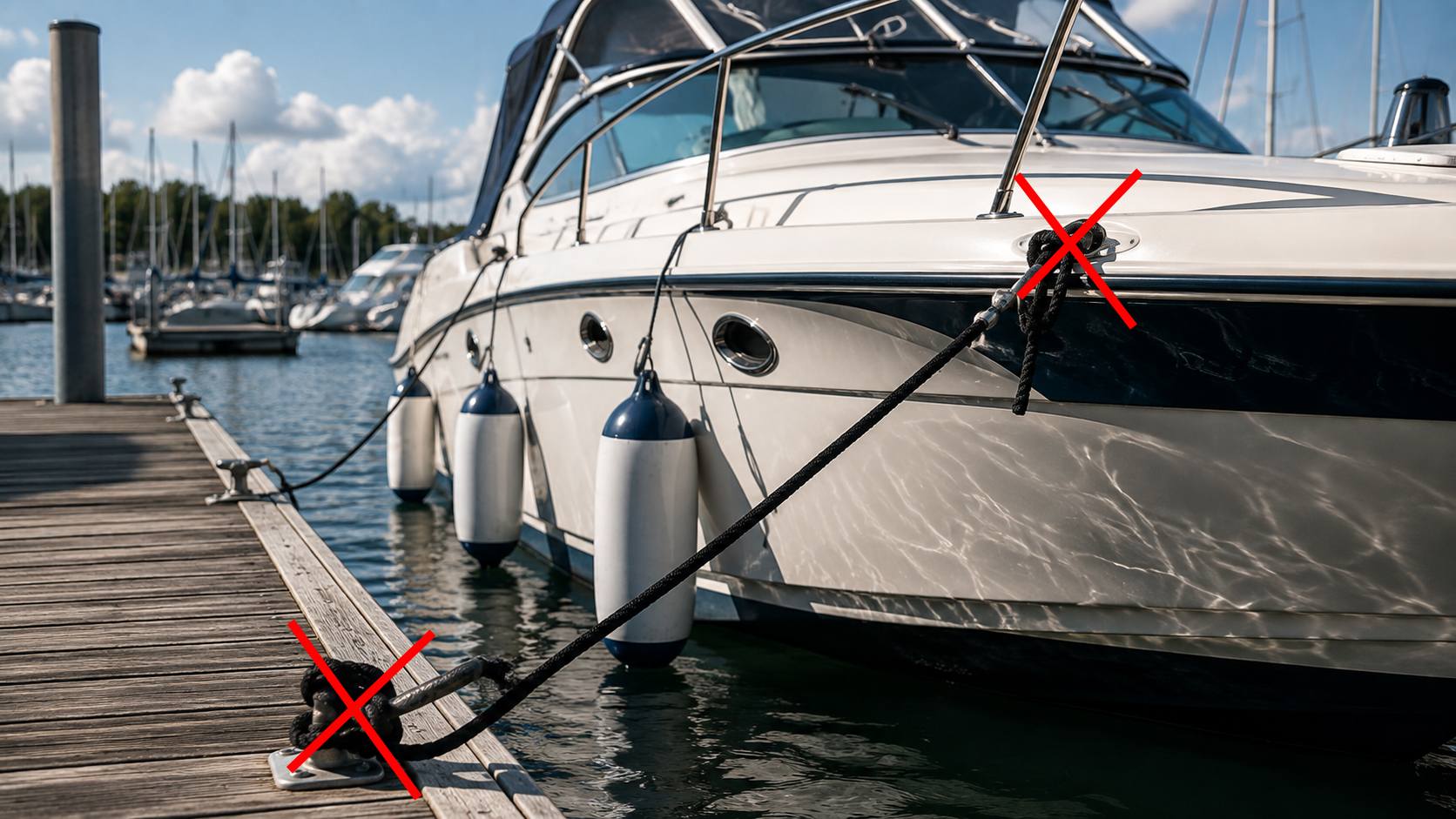
The four-line principle for side
mooring
The traditional
and effective way to secure mooring lines follows the four-line principle:
Bow line (head
line) – Runs forward from the boat's bow to a cleat on the dock and keeps the
bow from swinging away from the dock.
Stern line – Runs
aft from the stern and keeps the stern from swinging away from the dock.
Forward spring
line – Runs aft from the bow and prevents the boat from moving forward.
Aft spring line –
Runs forward from the stern and prevents the boat from moving backward.
Spring lines are
the most important element of dock mooring. They prevent the boat's
fore-and-aft movement and significantly reduce the strain on the other lines in
strong wind.
Correct line length and angle
Mooring to a dock
works best when the lines are the right length and at the right angle. The bow
and stern lines should form an angle of about 45 degrees to the boat's long
axis. Spring lines, on the other hand, run almost parallel to the boat. The
lines should be long enough to allow the boat to rise and fall as the water
level changes.
Mooring to a finger berth
Mooring to a
finger berth is typical in Finnish small-boat harbors. In a finger berth, the
boat is secured bow or stern toward the dock, with one end tied to the dock
with lines and the other end secured to the finger poles.
Bow-to-dock mooring
The most common
finger-berth mooring method is bow-to-dock. In this method, the boat's bow is
secured to the dock and the stern to the finger poles. Mooring proceeds as
follows:
Approach the spot
calmly, bow toward the dock.
Pick up the pole
line and secure it to the finger poles using a quality mooring line.
Continue in under
control toward the dock and stop in good time before reaching it.
Secure the bow
lines to the dock's mooring points – one on each side.
Adjust the pole
line to a suitable tension so the boat doesn't hit the dock.
Then adjust the
bow lines to a suitable tension.
Stern-to-dock mooring
Some harbors use
stern-to-dock mooring, where the boat's bow points out to sea. This is a less
common method in Finland, but is favored, for example, in the Mediterranean.
The mooring principle is the same as bow-to-dock mooring, but reversed.
Pole line length and give
A pole line
that's too tight puts unnecessary strain on the cleats and poles, while a pole
line that's too loose lets the boat bump against the dock or the poles. The
optimal pole line length is about 1.5–2 times the distance from the bow to the
pole.
Mooring to shore and anchoring
Mooring to shore
is an essential skill for cruising boaters and anyone navigating the
archipelago. Shore mooring can be done with an anchor and shore lines.
Anchoring is a broad topic you can read about in more detail in our
comprehensive boat anchoring guide.
Anchoring in a natural harbor
When mooring by
anchoring, proceed as follows:
Choose a
sheltered spot where the bottom is suitable for anchoring (sand, clay, or mud).
Check the water
depth – the anchor rode should be at least 3–5 times the water depth.
Lower the anchor
calmly to the bottom and let the boat drift back with the wind or current, or
under engine power. Make sure
the engine or propeller doesn't hit the bottom or rocks.
Tighten the line
and check the anchor's holding by pulling against it.
Come ashore
carefully and secure the bow to shore, for example to trees or using a rock
anchor wedge.
Finally, tighten
the lines so the boat's bow can't hit the shore. If you're staying overnight on
the boat, it's a good idea to adjust the lines to keep the boat a little
further from shore overnight, in case changing conditions cause damage to the
boat.
The length of the
anchor rode is the single most important factor in anchor holding. A rode
that's too short causes a vertical pull, which makes the anchor come loose from
the bottom easily.
Shore mooring
safety
Several safety
aspects need to be considered when mooring to shore:
Bottom quality –
Check that the anchor gets a good hold. An anchor won't bite on rock; sand and
mud bottoms are best.
Wind direction –
Choose a spot where the boat is as sheltered as possible from the prevailing
and forecast wind.
Water level
changes – Account for a possible drop in water level overnight, especially on
large bodies of water.
Shore line
attachment points – Make sure trees or rocks can bear the load. Rotten trees
and loose rocks are dangerous attachment points.
Escape route –
Make sure you can leave quickly if the wind shifts or picks up.
Stern-to-shore mooring
A less common
method in the Finnish archipelago is to moor the boat stern-to-shore and drop
the anchor from the bow. On some boat models, this makes it easier to get
ashore.
Approach the
shore slowly and drop the anchor at a suitable distance.
Let the boat
drift calmly toward shore while paying out the anchor rode.
Secure the stern
lines to sturdy trees or rocks.
Adjust the anchor
rode so the boat stays a safe distance from shore.
The most important knots for
mooring a boat
Securing mooring
lines requires mastering a few basic knots. A good knot is easy to tie, holds
securely, and is easy to release even under tension.
Bowline (Paalusolmu)
The bowline is
the boater's most important knot. It forms a fixed loop that won't slip at the
end of a line and is easy to untie even after the line has been under heavy
load. Used especially for securing a line to a bollard.
Cleat hitch (Knaapisolmu)
The cleat hitch
is the fastest way to secure a line to the boat's cleat. Tied correctly it
holds securely but is still easy to release. Basic method: one full turn around
the base of the cleat, then crossing figure-eight wraps, and finally a locking
hitch.
Practicing knots
Experienced
boaters recommend practicing knots at home before heading out for the season.
As a rule of thumb, you should be able to tie the knot even with your eyes
closed and in the dark. This matters because the most critical mooring
situations often happen in poor conditions – darkness, rain, or strong wind.
Mooring line care and storage
Quality mooring
lines are a significant investment, and proper care can extend their lifespan
considerably. Regular inspection and maintenance ensure the lines work reliably
exactly when you need them most.
Cleaning the lines
Salt crystals
left by seawater wear down the line's fibers and weaken its strength. Rinse
mooring lines with fresh water at the end of every boating season, and more
often if you spend a lot of time in very salty water. Some dirty lines can be
washed in a washing machine with a mild detergent at 30 degrees.
Drying and storing the lines
A wet line should
always be dried before storage. Moisture promotes mold and microbial growth,
which weaken the line's structural strength. Store lines in a dry, cool, dark
place – UV radiation makes polyester and nylon brittle especially quickly.
Avoid storing lines under pressure or bent for long periods. At the end of the
boating season, line care is part of the broader process of winterizing the
boat, when the whole vessel is prepared for winter.
Inspecting the lines
Check mooring
lines for the following types of damage:
Fraying – worn
areas where fibers have broken
Hardening –
brittleness caused by UV exposure
Discoloration –
can indicate internal damage
Flattening –
structural weakening
Strand separation
– especially in braided lines
If a line shows
clear signs of damage, it should be replaced immediately. A damaged line can
fail without warning, and the consequences can be serious.
Boat mooring equipment – what do
you need?
Quality boat
mooring equipment is an investment in safety. Correctly chosen equipment lasts
year after year and protects your boat effectively.
Mooring lines
Choose mooring
lines that suit your boat's size. Small boats typically use about 8–16 mm
mooring line, depending on the boat's size, weight, and mooring method. Polyester lines are popular
mooring lines thanks to their durability and tensile strength.
Fenders
Fenders
protect the boat's side from bumps against the dock and neighboring boats.
Choose fender size according to the boat's length and always use them while
moored. Cylindrical fenders are the most versatile, but round fenders are also
well suited to protecting the stern.
Mooring line snubbers
Mooring
line snubbers dampen the jerking caused by waves and wind, which puts strain on
the boat, the lines, and the dock structures. Snubbers can significantly reduce
jerking and protect the boat, the lines, and the dock's mooring points.
Mooring line and boat
size chart
The most common mooring
mistakes
Boaters
often repeat the same mooring mistakes, which can lead to boat damage. Here are
the most typical mistakes and how to avoid them:
1. Lines that are too
short
Lines
that are too short don't allow enough slack for changes in water level. This
can cause major problems especially in tidal areas or on lakes where the water
level varies.
2. Missing spring lines
in side mooring
Many
boaters secure the boat with only bow and stern lines, which lets the boat move
fore and aft. Spring lines
are essential for a stable mooring.
3. Worn lines
Line condition
should be checked regularly. Brittle, frayed, or UV-weakened lines can fail at
exactly the critical moment.
4. Missing or incorrectly placed
fenders
Too few or
incorrectly placed fenders don't protect the boat effectively. Fenders should
be positioned at the boat's widest point and at the height of the mooring
points.
5. Knots coming undone
Carelessly tied
knots can come loose under strain. Always use proper boating knots and check
the mooring before leaving the boat.
Mooring in different weather
conditions
Weather
conditions significantly affect boat mooring. In normal conditions, basic
mooring is enough, but when a storm warning is issued, extra measures are
worthwhile.
Storm mooring
Use doubled lines
– two lines at every mooring point.
Add extra
fenders, especially at the boat's widest points.
Check all mooring
points and knots.
Consider moving
the boat to a more sheltered spot if possible.
Use line snubbers
to dampen sudden jerks.
Check current
marine weather and wind warnings from the Finnish Meteorological Institute
before leaving the boat at the dock. Preparing for these situations is part of
responsible boating.
Comparing mooring methods –
which suits you?
Different mooring
methods suit different situations. The comparison below helps you choose the
right method:
Frequently asked questions about
mooring a boat
How many lines do I need to moor
a boat to a dock?
Basic dock
mooring requires at least four lines: two bow lines and two stern lines. In harsher conditions or for longer-term
storage, six lines are recommended.
What's the right line diameter
for my boat?
It depends on the
line's strength rating and the mooring points. Line manufacturers and retailers
usually state the line's breaking strength, which should generally be at least
about half the boat's weight. Lines that are too thick are difficult to secure
to, for example, cleats.
How often should mooring lines
be replaced?
Mooring line
condition should be checked at least once a year. Lines that have been exposed
to a lot of UV radiation, chafing, or heavy strain should be replaced every 3–5
years, even if they still look fine on the outside.
How do I choose the right size
fender?
The shape
of the boat determines fender size. For example, an 8-meter boat suits a fender
roughly 16–24 cm in diameter. Use at least three fenders per side if possible.
Why does mooring a boat
often fail?
The most
common reasons for failed mooring are lines that are too short, missing spring
lines, worn lines, and incorrectly placed fenders. Carelessly tied knots and
underestimating weather conditions also cause problems. Going through a
checklist before leaving the boat at the dock can prevent most problems.
What do I do if the boat starts
drifting?
If you notice the
boat has drifted loose, stay calm. If you're on board, try to start the engine
and steer the boat to a safe location. If your boat has drifted without you on
board, contact the maritime rescue service immediately (VHF channel 16 or emergency
number 112) and report the boat's identifying details and location. Don't try
to swim after the boat.
Summary: Safe boat mooring
Properly done
mooring protects your vessel and gives you peace of mind. Remember these key
principles: always use lines that are thick and long enough, secure spring
lines when mooring to a dock, protect the boat with fenders, and use snubbers
to dampen strain. Quality mooring equipment pays for itself many times over in
damage avoided.
Browse
Marinekauppa's extensive range of mooring lines, fenders, line snubbers, and
anchors – everything you need for safe boat mooring is available in our
webshop!
Sources and further reading
Boat Anchoring
Guide – A comprehensive guide to anchor types and anchoring techniques
Suomen Purjehdus
ja Veneily ry (Finnish Sailing and Boating Federation) – Boating safety
guidelines and training
Traficom –
Boating rules and regulations
Finnish
Meteorological Institute – Weather services and marine warnings
|
Boat length |
Line diameter |
Line length (bow/stern) |
Recommended fender size |
|
Under 6 m |
8–10 mm |
6–8 m |
10 × 40 cm |
|
6–9 m |
10–12 mm |
8–12 m |
15 × 58 cm |
|
9–12 m |
12–14 mm |
12–15 m |
18 × 65 cm |
|
12–15 m |
14–16 mm |
15–20 m |
21 × 76 cm |
|
Over 15 m |
16–20 mm |
20+ m |
24 × 90 cm |
|
Mooring method |
Suitability |
Advantages |
Challenges |
|
Dock mooring |
Harbors, guest berths |
Stable, easy to step ashore |
Requires 4–6 lines, spring lines important |
|
Finger berth
(stern-to-dock) |
Small-boat harbors |
Easier access, good protection |
Requires practice, pole-line adjustment |
|
Buoy mooring |
Home harbor, guest harbors |
Flexible,
easy to cast off |
Depends on the
buoy's condition |
|
Anchoring |
Natural harbors, open-water fishing |
Freedom to
choose your spot |
Bottom quality is critical |
|
Shore mooring |
Archipelago cruising |
Close to
nature, when it's the only option |
Weather-dependent, line length |
Disclaimer
This guide provides general guidance only and does not replace the product manufacturer's operating, installation, or service instructions. Marinekauppa is not responsible for actions taken based on this guide or their consequences. Always check product-specific instructions and consult a qualified professional if needed.