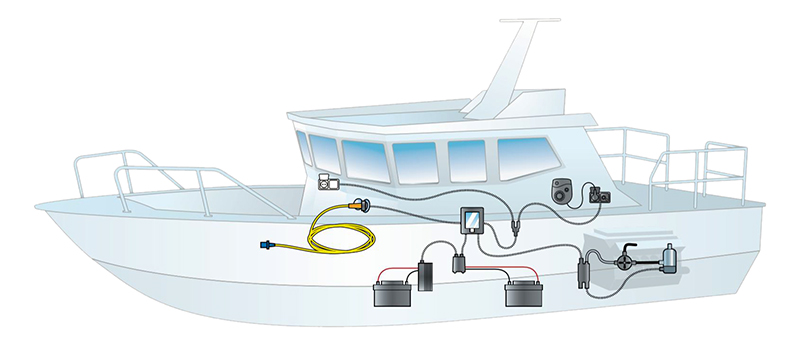
Shore power for your boat is an essential
add-on that lets you connect your boat to the marina's electrical grid. Shore
power provides a continuous power supply to the boat's electrical equipment,
charges the batteries efficiently, and improves comfort at the dock. A correctly installed shore power system
for your boat ensures safety and prevents costly corrosion damage.
Why does shore power matter on a
boat?
Shore power for
your boat brings significant benefits from the perspective of comfort, safety,
and economy alike. Comfort during time spent at the dock improves considerably
when all electrical equipment works without draining the batteries.
A continuous
power supply allows battery chargers to run efficiently, keeping the boat's
batteries full and ready for the next trip. Generator use is significantly
reduced, which cuts fuel costs and reduces noise at the marina. Shore power is
also an environmentally friendly solution, since it eliminates generator
exhaust emissions and noise.
Wiring shore
power on a boat, however, requires careful planning and the use of the right
supplies. An incorrectly installed shore power system can create serious safety
risks and costly corrosion damage to the boat's metal parts.
Basic components of a shore power system
A boat's shore
power system consists of several components that together guarantee a safe,
reliable power supply. At the core of the system are always a residual-current
device (RCD/GFCI), quality connectors and cables, and, where appropriate, a
galvanic isolator to prevent corrosion.
Residual-current device – the
most important safety component
A
residual-current device (RCD) is an absolutely essential part of a boat's shore
power system. The ISO 13297
standard requires a 30mA RCD on all boat shore power installations. An RCD
detects even small fault currents and cuts the power supply within
milliseconds, preventing the risk of electric shock.
An RCD is
especially protective in situations where a fault current travels to ground
through water or the boat's metal parts. Without an RCD, even a small fault in
an electrical device can be life-threatening in a wet marine environment. Shore
power systems generally come with an RCD built in.
An RCD is a
boat's shore power system's most important safety component, preventing
electric shocks and ensuring safe use in all conditions.
Connectors and cables – choosing
to standard
Connecting shore
power requires a CEE connector compliant with the IEC 60309 standard, which is
common at marina power points across Europe. The most common is the blue 16A
230V CEE connector, rated IP44 (splash-proof). Larger boats may need a 32A
connector instead.
A boat's shore
power cable should have a cross-section of at least 2.5mm² and be made of
H07RN-F or H07BQ-F rubber-sheathed cable suited to marine conditions. These
cables withstand mechanical stress, UV radiation, and moisture far better than
ordinary extension cords. Shore power cables are designed specifically for
marine use and meet all safety standards.
IEC
60309-compliant connectors are watertight and designed to work in temperatures
from -25°C to +40°C. The connector's pins are arranged so the earth pin
connects first and disconnects last, ensuring a safe connection.
Distribution panel and
connecting electrical equipment
A shore
power panel is needed inside the boat to safely distribute power to different
equipment. The panel includes an RCD, a main switch, and, where needed,
separate fuses for different circuits. Modern shore power systems, such as the
Ratio AC16, are plug-and-play and make installation considerably easier.
Battery
chargers, heaters, galley equipment, and other 230V devices can be connected
directly from the shore power panel. It's worth installing outlets at
convenient points around the boat to make using different equipment easier.
How do you wire shore
power to a boat safely?
Wiring shore
power to a boat requires careful planning and following correct installation
practices. Safety always comes first, since an incorrectly installed system can
create a risk of electric shock or corrosion damage.
Step-by-step guide to wiring
shore power
1. Install the
shore power inlet on the boat's exterior: A watertight CEE inlet (16A or 32A)
is installed on the boat's side, to which the marina's shore power cable is
connected. Shore power inlets are made of UV-stabilized plastic or stainless
steel and withstand marine conditions.
2. Install the
shore power panel inside the boat: The panel is placed in a dry location,
protected from splashing. The panel must include a 30mA RCD and a main breaker.
The Ratio AC16 and other modern systems are easy to install without a
professional electrician.
3. Wire the
cabling correctly: The shore power cable coming from outside the boat is
connected to the shore power panel. The cable has three conductors: live
(brown), neutral (blue), and protective earth (green-yellow). Wiring must be
done according to the manufacturer's instructions.
4. Install a
galvanic isolator (recommended): A galvanic isolator is installed in the
protective earth conductor to prevent corrosion currents. The isolator is
especially important for protecting metal propellers, drive units, and the
engine.
5. Test the
system: Before use, the system should be tested using the RCD's test button.
Also make sure all connections are tight and that there are no loose wires
anywhere.
Galvanic isolator – the
foundation of corrosion protection
A galvanic
isolator is a small but important component that prevents corrosion damage to a
boat's metal parts. When a boat is connected to shore power, a small potential
difference can arise between the marina's electrical grid and the boat's 12V
system, causing corrosion currents.
These currents
travel through the shore power earth conductor to the boat's metal parts, such
as the propeller, rudder, and the engine's metal components. Over time,
corrosion currents can cause significant damage and costly repairs.
A galvanic
isolator consists of two diodes connected back-to-back in parallel. The diodes'
threshold voltage is about 1.4V, which is higher than the potential difference
typical of the metals used on a boat. This means the isolator blocks small DC
currents from passing while still allowing AC voltage through, and in a fault
situation lets higher currents through so the RCD operates normally.
A galvanic
isolator is essential especially on aluminum and steel boats, but it's worth
installing on fiberglass boats too, to protect expensive metal components.
The most common mistakes and
safety risks
Shore power
installations unfortunately often contain mistakes that can create serious
safety risks or costly corrosion damage. Here are the most common mistakes and
how to avoid them.
Mistake 1:
Connecting the protective earth to the 12V negative
This is the most
common and most serious mistake. When shore power's protective earth is
connected to the boat's 12V negative, it creates an effective "corrosion
machine" that can quickly destroy the propeller, drive unit, and the
engine's metal parts. On fiberglass boats, the protective earth should be kept
completely separate from the 12V system. On steel boats, the protective earth
is connected to the boat's hull, but in that case a galvanic isolator is
absolutely necessary.
Mistake 2: A
cable that's too thin
The IEC 60309
standard requires at least a 2.5mm² cable for 16A connections. A cable that's
too thin overheats and creates a fire risk. Thin cables also don't withstand
the mechanical stress of marine use.
Mistake 3:
Missing RCD
Sometimes a shore
power system is built without an RCD, which is a serious safety risk. An RCD is
mandatory under the ISO 13297 standard and can save a life.
Mistake 4: Wrong
connectors or adapters
Ordinary
household (Schuko) plugs shouldn't be used for a boat's shore power connection
without proper adapters that meet safety requirements. The CEE connector is designed for marine
conditions and is the only safe option.
Mistake 5:
Continuous connection without a galvanic isolator
If a boat is
continuously connected to shore power without a galvanic isolator, corrosion
damage can become significant within just a few weeks. Corrosion progresses
especially fast in salt water.
Supplies needed for wiring shore
power
Building a
complete shore power system requires several different components. Here's a
list of the essentials:
Basic supplies:
Shore power
system (includes RCD and distribution panel)
Shore power
cable, 15–25m, IEC 60309 CEE connectors, min. 2.5mm²
Shore power inlet
for the boat (16A or 32A)
Galvanic
isolator, 16A (strongly recommended)
Extra supplies:
Battery charger
for efficient battery charging
Inverter
for 12V/230V conversion where needed
Adapters
for different outlet types
Extra
outlets for inside the boat
Cable bag
for storing the shore power cable
Quality
supplies cost a bit more upfront, but they guarantee safe use and a long
service life. Cheap components can create safety risks and may fail quickly in
marine use.
What should you consider
when choosing a shore power system?
Choosing
the right shore power system depends on the boat's size, the power needs of the
equipment you'll use, and the operating conditions. Small motorboats generally
do fine with a simple 16A system, while larger sailboats or boats designed for
long-term marina use benefit from a 32A system.
Factors
to consider:
Power
needs: Add up the power draw of all equipment used simultaneously. 16A 230V =
max power 3,680W; 32A = 7,360W.
Battery
charger power: Larger battery banks need a powerful charger, which affects the
maximum current required.
Heating
and air conditioning: These are the highest-power devices and may require a 32A
connection.
Ease of
future expansion: Plug-and-play systems, such as the Ratio AC16, make it easier
to expand the system later.
When
choosing a galvanic isolator, it's worth considering the boat's hull material.
For metal-hulled boats (aluminum, steel), an isolator is nearly mandatory,
while on fiberglass boats it's strongly recommended, especially if shore power
is used long-term.
Shore power maintenance
and inspections
Regular
maintenance and inspections ensure the shore power system keeps working safely
year after year. At the start of the season, it's worth checking all components
carefully.
Annual
checks:
Test the
RCD using its test button – it should trip immediately
Check the
condition of the cables – cracks, worn spots, and connectors
Clean the
CEE connectors and make sure they close tightly
Check
that the galvanic isolator is working (if installed)
Check
that outlets are sealed and connections are snug
At the
end of the season, it's worth disconnecting the shore power cable, cleaning it,
and storing it somewhere dry. Connectors should be protected with dust caps or
stored in a cable bag. It's worth testing the RCD a few times during the season
to confirm it's working.
If the
system develops faults, such as the RCD tripping repeatedly for no apparent
reason, it's worth contacting a professional. Troubleshooting electrical
systems requires proper meters and expertise.
Get quality shore power
products from Marinekauppa!
In
Marinekauppa's extensive shore power range you'll find everything needed to
build a safe, reliable shore power system. We offer quality shore power
systems, cables, and connectors, plus expert advice. Browse our range and order
the products you need easily from our webshop!
Sources
IEC 60309
– International standard for plugs, socket-outlets and couplers for industrial
purposes
ISO 13297
– Small craft – Electrical systems – Alternating current installations
Victron Energy –
Technical documentation on galvanic isolators
Kipparilehti.fi –
Electricity and metals don't mix, but corrosion is forever (2023)
Disclaimer
This guide provides general guidance only and does not replace the product manufacturer's operating, installation, or service instructions. Marinekauppa is not responsible for actions taken based on this guide or their consequences. Always check product-specific instructions and consult a qualified professional if needed.


