Antifouling Paints (Bottom Paints)
SEE MARINEKAUPPA’S ANTIFOULING PAINTS
There are many different types of antifouling paints on the market, each with its own strengths and weaknesses. Antifouling paint is essential for preventing the growth of marine plants and organisms on boat hulls and other underwater surfaces. While the use of these paints has certain drawbacks, they offer significant advantages for the performance and efficiency of a boat. Today, much discussion surrounds the environmental impact of antifouling paints, especially regarding the release of harmful substances into the water and the positive effect clean hulls have on reducing fuel consumption.
Types of Antifouling Paints
Copper-Based Antifouling Paints
These are the most effective and most common antifouling paints. They kill algae and marine growth on contact. However, they can be toxic to marine life and may leach into the water, causing environmental issues.
Silicone-Based Antifouling Paints
These paints are generally less aggressive than copper-based paints but are far more environmentally friendly. They work without releasing toxins; instead, their slippery silicone surface makes it difficult for organisms to attach.
Sol-Gel Technology Antifouling
These are fully non-toxic antifouling coatings. They create a hard, smooth surface from which attached organisms can be easily brushed off with special tools.
How to Choose the Right Antifouling Paint for Your Boat
With so many products available, choosing the right antifouling paint can be challenging. Keep the following factors in mind:
1. Type of Boat
Different boats require different types of antifouling.
-
Racing boats: need very hard paint for maximum speed
-
Leisure boats: require durable, long-lasting paint
-
Slow boats and sailboats: commonly use soft paints that rely on controlled leaching
2. Water Type
-
Saltwater: Many antifouling paints are suitable
-
Freshwater (lakes): Toxic antifouling paints are prohibited; use only eco-friendly products or avoid painting altogether
(e.g. eco paints such as Sol-Gel coatings or silicone-based paints)
3. Brand
Different regions and boating clubs often favor specific brands because they perform well in local conditions. Ask other boaters or check what is commonly used in your area.
4. Surface Type and Condition
-
Are you touching up existing paint or repainting entirely?
-
Important: Never apply hard paint over soft paint — it will not adhere properly.
-
Aluminum boats: Avoid copper-based paints entirely, as they will corrode aluminum. (International Trilux is one exception but still requires multiple coats of primer.)
Preparing and Painting the Hull
Removing Old Antifouling
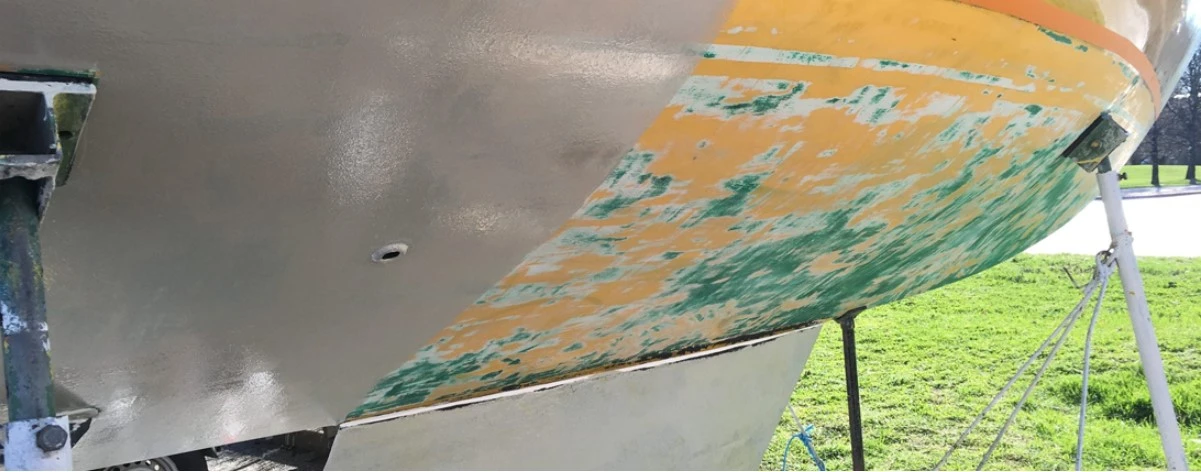
Removing old paint is not always necessary; many boat owners simply apply a new coat over the old one.
BUT: Never apply harder paint over softer paint.
Antifouling paints can be divided into three categories:
-
Soft
-
Self-polishing
-
Hard
A fresh coat is usually applied every spring, or at least every other year.
If you choose to remove old paint, these methods can be used:
Paint Removers
Chemical paint removers soften the surface for scraping. After applying the remover, cover the area with aluminum foil to slow evaporation. Let it work for 15–30 minutes before scraping.
Caution: Paint removers can damage ABS plastic.
Wet Sanding
Old antifouling can be removed by wet sanding with coarse sandpaper.
⚠️ Never dry sand antifouling paint, as toxic dust may be inhaled.
Always use protective equipment when handling antifouling products.
Cleaning and Preparing the Surface
Before applying new paint, always clean the hull thoroughly:
-
Remove all dirt, oil and grease (thinner is suitable for cleaning)
-
Fill cracks and dents with a filler suitable for underwater use
Sanding the Surface to Proper Roughness
If the hull has been stripped down to bare gelcoat:
-
Sand gelcoat with 150–180 grit paper before applying primer
-
Primer should not be sanded; apply antifouling while the final primer coat is still slightly tacky
If the old antifouling is hard paint:
-
A porous surface layer forms over the season — remove it by wet sanding
⚠️ Never dry sand antifouling paint.
SEE MARINEKAUPPA’S SANDING TOOLS
Applying Antifouling Paint
If painting over old, poor-condition soft antifouling, apply a layer of 1-component primer first.
When switching paint types, a primer coat is also required.
Applying with a Brush
A simple and inexpensive method. Best for uneven surfaces. Use the widest possible brush for faster coverage. Apply paint using a cross-coating technique.
Applying with a Roller
The fastest method for large surfaces.
-
Foam rollers: smoothest finish
-
Mohair rollers: fastest application
⚠️ Foam rollers cannot be used with thinner-based products, as they dissolve.
Number of Coats
-
Over existing antifouling: usually 1 coat
-
On a fully cleaned hull:
-
3–5 layers of 2-component primer
-
1 layer of 1-component primer
-
2 coats of antifouling paint
-
SEE MARINEKAUPPA’S PAINTING TOOLS
Choosing the Right Antifouling Paint
Important Factors
Water Type
-
Freshwater: only non-biocidal or silicone paints allowed
(e.g. Hempaspeed TF, B-Free Explore, Silic One)
Hull Material
Different substrates require different products.
Recommended Products by Boat Type & Water Type
Motorboat (fiberglass), saltwater
-
Hempel Hard Racing Xtra – hard paint for fast boats
-
International Trilux – hard paint for fast boats
-
Hempel Silic One – silicone-based, very low friction
-
International B-Free Explore – fully biocide-free
Sailboat (fiberglass), saltwater
-
Hempel Mille Xtra – self-polishing copper-based
-
Hempel Silic One – silicone-based
-
International B-Free Explore – biocide-free
Wooden Boats, saltwater
-
Hempel Classic – traditional copper-based
⚠️ Silicone-based paints are not recommended for flexible, breathing wooden hulls.
Aluminum Boats, saltwater
-
International Trilux Hard
→ Always apply 2–3 coats of epoxy primer first -
Hempel Hempaspeed TF – biocide-free
-
International B-Free Explore – biocide-free
-
Hempel Silic One – silicone-based
⚠️ Copper-based paints are not suitable for aluminum.
Primers & Thinners
1. Compatible Primers
| Substrate | Recommended Primer |
|---|---|
| Fiberglass (for antifouling) | Hempel Light Primer (2K epoxy) |
| Wood | Hempel Underwater Primer |
| Aluminum | Hempel Light Primer or International Yacht Primer |
| Old antifouling / uneven surface | Hempel Underwater Primer |
| Silicone coatings | Hempel Light Primer, Hempel One Tiecoat (and Conversion Primer), International B-Free Tiecoat (and Conversion Coat) |
If switching paint types (e.g. copper → biocide-free), always use the correct tiecoat.
2. Thinners (product-dependent)
| Product | Thinner |
|---|---|
| Hempel Mille Xtra, Hard Racing Xtra, Classic | Hempel Thinner 808 |
| Hempel Underwater Primer | Hempel Thinner 811 |
| Hempel Primer Undercoat | Hempel Thinner 811 |
| Hempel Light Primer | Hempel Thinner 845 |
| International One-Up Primer | International Thinner No.1 |
| International Trilux Hard | International Thinner No.3 |
| Hempel Silic One | ❌ Not thinned |
| International B-Free Explore | ❌ Not thinned |
Use thinner only when necessary (e.g. spray application).