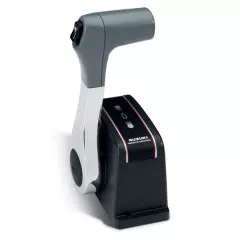
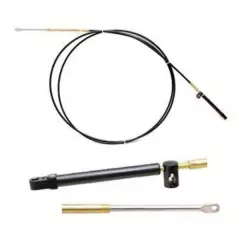
Remote control devices and cables
Throttle and shift cables and their controls.Tuoteryhmät
A boat remote control is a part of a control system that allows you to control your boat's engine and its functions from a control point. Remote controls allow you to adjust engine speed, gears, and other engine functions safely and accurately. Discover our boat remote controls, remote control cables, and other accessories!
A boat's remote control device acts as an intermediary between the control center and the engine, allowing the user to easily and accurately control engine speed, gears, and trim. The operating principle of the remote control device depends on whether it is a mechanical, electrical, or electronic control device.
Mechanical boat remote control device
Mechanical systems use remote control cables (so-called wires) to transmit control commands from the control point to the motor.
When the operator moves the control lever, the movement is transmitted via the remote control cable to the engine throttle or transmission.
The throttle and gears operate linearly: the further the lever is pushed, the higher the engine speed or the faster the gear changes.
Mechanical systems are simple and reliable, but they can require more power and regular maintenance, such as lubrication and cable tensioning.
Electronic boat remote control device
Electrical controls use electric motors or relays to transmit commands to the motor.
The user's movement on the control lever sends an electrical signal that controls the engine's throttle or transmission.
Electronic controls are more precise and require less force than mechanical systems.
Electrical systems are more sensitive to moisture and require good electrical connections.
Electronic remote control device
Electronic systems, such as drive-by-wire, transmit control commands using completely digital signals.
When the operator moves the control lever, a signal is sent to the engine control unit (ECU), which executes a command, such as adjusting the throttle or changing gears.
Electronic systems are very precise, smooth and require little physical strength.
They may include additional features such as engine trim control, synchronization of multi-engine systems, and automatic functions.
Throttle adjustment
The control lever controls the engine speed.
Small movements on the lever adjust the revs subtly, while larger movements give more power to the engine.
Gear management
The remote control usually has two main positions: forward and aft. The middle position is neutral, meaning the boat will not move even when the engine is running.
Some controls operate the throttle and gears with a single lever, while others have separate levers.
Trim
Many remote controls include a button for engine trim , allowing the engine position to be adjusted for optimal operation.
Trimming helps improve the performance and fuel efficiency of your boat.
Additional functions
Many modern controls can have an integrated engine start and stop function and automatic idle control.
Control lever movement: The operator moves the control lever forward or backward to adjust engine speed and gear.
Multi-engine systems: On boats with multiple engines, the remote control can control all engines in sync, making operation easier.
Controls and buttons: On electronic models, buttons can provide additional functions such as trimming and fine-tuning speed.
Safety:
Precise and fast engine control improves boat maneuverability and makes driving safer .
Comfort:
The user can control the engine ergonomically without having to go to the engine.
Efficiency:
Engine management optimizes boat performance and reduces fuel consumption.
The boat remote control device, together with the remote control cable, acts as a bridge between the control point and the engine, giving the user precise and safe control. Mechanical, electrical and electronic systems offer different options depending on the purpose and needs of the boat. A well-chosen control device makes boating more comfortable, safer and more efficient.
The remote control cable is a mechanical component of the control system that transfers the user's movements from the remote control device to the boat's engine. The remote control cable is used, for example, to control the throttle and gears. The remote control cable is designed to withstand the challenges of boating conditions, such as moisture, salt water and vibration.
Gas control:
The remote control cable transfers the movement of the control device to the engine throttle, adjusting the engine speed.
This allows precise control of engine power and speed.
Gear control:
The remote control cable allows the remote control device to change gears, for example forward, reverse or neutral.
Gear shifting is controlled smoothly through cable-transmitted movements.
Inner cable:
The inner cable is made of durable metal and is responsible for the actual transmission of movement.
Exterior:
The outer sheath protects the inner cable from environmental factors such as moisture, salt and mechanical damage.
It is usually made of durable plastic or rubber.
Terminal connectors:
The remote control cable has connectors at both ends that attach to the remote control device and the corresponding part of the motor. These ensure smooth and precise transmission of movement.
Installation: The remote control cable is installed between the boat's remote control device and the engine. The remote control cable must be attached correctly to ensure accurate and trouble-free movement.
Operation: The operator controls the engine with the levers on the control unit, and the remote control cable transmits the movements to the engine throttle and transmission.
Maintenance: Regular cleaning and lubrication will extend the life of the remote control cable and ensure its functionality.
The remote control cable is an important part of the boat's control system, as it transmits the user's commands from the remote control device to the engine accurately and reliably. A properly selected, installed and maintained cable ensures smooth and safe boating in all conditions.
Engine type:
Choose a device that is compatible with your boat's outboard, sterndrive, or inboard engine.
Intended use:
Boating conditions and engine power will determine whether you need a simple mechanical device or a more sophisticated electronic system.
Installation location:
The location of the control point and the space available will influence the choice of device. Vertical and horizontal installations are common options.
Ergonomics and additional features:
Choose a device where the controls and buttons are easily accessible and comfortable to use.
Boat remote controls make engine control easy, safe and precise. They are a key part of a boat's steering system, and choosing the right device depends on the engine, the intended use and the needs of the user. Carefully selected and well-maintained remote controls ensure a pleasant and smooth boating experience. Discover our selection!