Victron Energy Argofet Battery Isolator 100A, 2 batteries
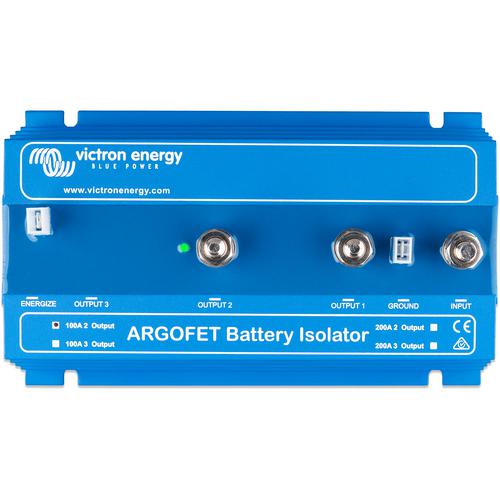
- For 2 battery groups
- 100A
- 12 and 24 volts
- 24/12 volt voltage range. Argofet automatically adjusts to 12 V or 24 V systems.
- For 2 battery groups
- Connection M8
- Size H65xW120xD200mm
- Weight 1.4kg
- Generator energy supply
FET isolators, like diode isolators, allow two or more batteries to be charged simultaneously from a generator without connecting the batteries together. Unlike diode battery isolators, FET isolators have virtually no voltage drop. The voltage drop is less than 0.02 volts at low currents and an average of 0.1 volts at higher currents.
A charging divider that allows two batteries to be charged simultaneously from a generator without connecting the batteries to each other. Unlike diode battery isolators, FET isolators have practically no voltage drop. The voltage drop is less than 0.02 volts at low currents and an average of 0.1 volts at higher currents. When using the ARGO FET battery isolator, there is no need to increase the generator output voltage. However, care must be taken to ensure short cable lengths and cables with sufficient cross-section.
Example: When a current of 100 A flows through a cable with a cross-section of 50 mm² (AWG 0) and a length of 10 meters, the voltage drop in the cable is 0.26 volts. Similarly, a current of 50 A through a cable with a cross-section of 10 mm² (AWG 7) and a length of 5 meters results in a voltage drop of 0.35 volts.
Some generators require DC voltage on the B+ output to start charging. Of course, DC is present when the generator is connected directly to the battery. However, placing a diode or FET divider will prevent the return voltage/current from the batteries to B+ and the generator will start. The new Argofet isolators have a special current limiting charging input that supplies power to B+ when the engine clutch is off.
Prodnr: 70860
Manufacturer prodnr: ARG100201020R
- For 2 battery groups
- 100A
- 12 and 24 volts
- 24/12 volt voltage range. Argofet automatically adjusts to 12 V or 24 V systems.
- For 2 battery groups
- Connection M8
- Size H65xW120xD200mm
- Weight 1.4kg
- Generator energy supply
FET isolators, like diode isolators, allow two or more batteries to be charged simultaneously from a generator without connecting the batteries together. Unlike diode battery isolators, FET isolators have virtually no voltage drop. The voltage drop is less than 0.02 volts at low currents and an average of 0.1 volts at higher currents.
A charging divider that allows two batteries to be charged simultaneously from a generator without connecting the batteries to each other. Unlike diode battery isolators, FET isolators have practically no voltage drop. The voltage drop is less than 0.02 volts at low currents and an average of 0.1 volts at higher currents. When using the ARGO FET battery isolator, there is no need to increase the generator output voltage. However, care must be taken to ensure short cable lengths and cables with sufficient cross-section.
Example: When a current of 100 A flows through a cable with a cross-section of 50 mm² (AWG 0) and a length of 10 meters, the voltage drop in the cable is 0.26 volts. Similarly, a current of 50 A through a cable with a cross-section of 10 mm² (AWG 7) and a length of 5 meters results in a voltage drop of 0.35 volts.
Some generators require DC voltage on the B+ output to start charging. Of course, DC is present when the generator is connected directly to the battery. However, placing a diode or FET divider will prevent the return voltage/current from the batteries to B+ and the generator will start. The new Argofet isolators have a special current limiting charging input that supplies power to B+ when the engine clutch is off.
Prodnr: 70860
Manufacturer prodnr: ARG100201020R

Recommended for you
CONTACT INFORMATION
STORES
Veneentekijäntie 3
00210 Helsinki (Lauttasaari)
FINLAND
mon–fri 9–18
sat 9-15
sun closed
VANTAA
Porttisuontie 13
00120 Vantaa (Porttipuisto)
FINLAND
mon–fri 10-18
sat 10-15
sun closed
COMPANY INFORMATION
Company ID 1827467-5
Founded in 2003


